I. Introduction
In the ion-exchange membrane industry, the SUPCON WebField series DCS has been successfully applied in over 50 sets. As of October 2006, the maximum application scale reached 250,000 tons per year. In the production process of ion-exchange membrane caustic soda, the SUPCON DCS is responsible for the fully automatic control of all processes, ranging from primary brine, secondary brine purification, electrolysis, dechlorination, Cl2 treatment, H2 treatment, Cl2 liquefaction, to caustic soda evaporation, achieving successful first-time commissioning. The SUPCON DCS has successfully established communication with the PLC of the brine Kelmembrane filter and fully assumed the sequential control of resin towers (2-5 towers) without requiring a dedicated PLC. This optimizes the control of all production processes in the electrolysis unit. In particular, SUPCON has accumulated extensive integrated experience in monitoring unit cell voltages in electrolyzers, successfully implementing safety interlock protection under various electrolysis process conditions.
II. Brief Introduction to the Process Flow
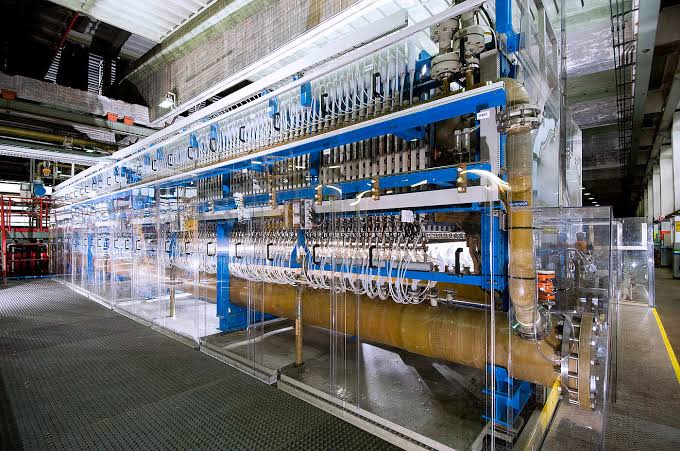
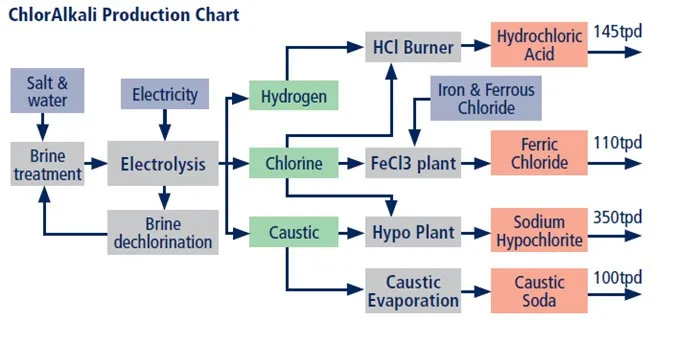
The electrolysis section is the key process in caustic soda preparation. When purified brine that meets electrolysis specifications flows through the electrolyzer, ions migrate through the ion-exchange membrane under the action of direct current. Ultimately, caustic soda is formed in the cathode liquid phase, dilute brine is produced in the anode liquid phase, H2 is generated in the cathode gas phase, and Cl2 is generated in the anode gas phase.
III. Control Strategy
3.1 Primary Brine Purification
3.2 Secondary Brine Purification
◆ Sequential control for normal filtration and regeneration.
◆ Switching and control for normal regeneration, double acid washing, and triple acid washing.
◆ Sequential control for filtration and regeneration during faults.
◆ Differentiated handling for long-term shutdowns and temporary shutdowns.
◆ Gap handling for switching to ensure the safety of field equipment.
◆ Since the regeneration tower serves as the main line while the other two towers filter in series, program switching is quite simple. Furthermore, SUPCON provides a step-by-step operation mode for the regeneration program, and the operating time for each step can be set in the parameter setting screen. Therefore, if the primary brine quality fails to meet standards and contaminates the resin tower, the resin can be easily cleaned and regenerated.
◆ During the execution of the sequential control program, many steps require judging the feedback signals of on-off valves to determine the next action. To prevent the feedback sensors of on-off valves from failing after long-term operation and thereby affecting the sequential control program, the system provides a selectable switch to bypass valve feedback signals. When a valve fault signal disrupts the sequential control program, if the operator confirms that the valve is functioning normally and the feedback sensor is faulty, they can choose to bypass the corresponding valve feedback signal, and the program will no longer evaluate it.
◆ During production, resin towers may undergo temporary shutdowns or long-term shutdowns for maintenance. Different shutdown methods have varying requirements for process fluid and valve control. SUPCON provides operation panels in the monitoring screens, allowing operators to easily select the appropriate shutdown mode.
3.3 Electrolysis
-
Loop Control
◆ Cl2-H2 Differential Pressure Control
A double closed-loop ratio control system. By adjusting the pressure in the Cl2 header and the H2 header, the hydrogen pressure is controlled to follow the chlorine pressure changes according to a specific variable ratio relationship.
◆ Control of Anolyte Recirculation Flow Rate
◆ Control of Pure Water Addition Flow Rate to Recirculated Caustic Soda
★ Forms a cascade control with caustic soda concentration.
★ Forms a ratio control with the total current of the Asahi Kasei electrolyzer; a ratio switch is used to toggle between them.
◆ Control of Purified Brine Flow Rate to the Electrolyzer
The purified brine flow rate to the electrolyzer forms a ratio control with the electrolyzer current, but the flow rate must not fall below a certain setpoint.
◆ Control of Acid Addition Flow Rate to the Electrolyzer Anode
The acid addition flow rate to the electrolyzer anode is adjusted based on a ratio control tied to the electrolyzer current.
◆ Detection of Anode/Cathode Differential Pressure Inside the Electrolyzer
The purpose of this detection is to protect the ion-exchange membrane and the normal operation of the unit cell. When installing transmitters, factors such as corrosion resistance, explosion-proofing, and insulation must be considered. -
Electrolyzer Interlock Protection
Electrolyzer interlocks consist of two parts: common interlocks and single-cell interlocks. Common interlocks include total plant power failure, complete shutdown of chlorine compressors, excessively high or low Cl2-H2 differential pressure, and instrument air failure. If any of these common interlocks are triggered, all electrolyzers will shut down via interlock. Single-cell interlock conditions include excessively high electrolyzer voltage, low purified brine flow rate into the cell, or low caustic soda recirculation flow rate. When a single-cell interlock condition is met, it only affects that specific cell.
IV. Typical Applications
Boasting 25 years of professional industry experience in production and supply, Chlory factory delivers premium,cost-effective chemical products with reliable quality. Worldwide exported to more than 50 countries, including Italy, USA, Saudi, Africa and other countries and some foreign companies are our agents locally. Equipped with fully automatic production systems and scientific modular production line design, we achieve stable output, high efficiency and low energy consumption while strictly complying with industrial standards. Different from ordinary manufacturers, Chlory provides flexible customized services tailored to diverse customer needs on product specifications, packaging and solutions. With direct factory pricing and optimized production processes, we help clients cut procurement costs and obtain high-quality, stable chemical supplies with comprehensive professional support.