
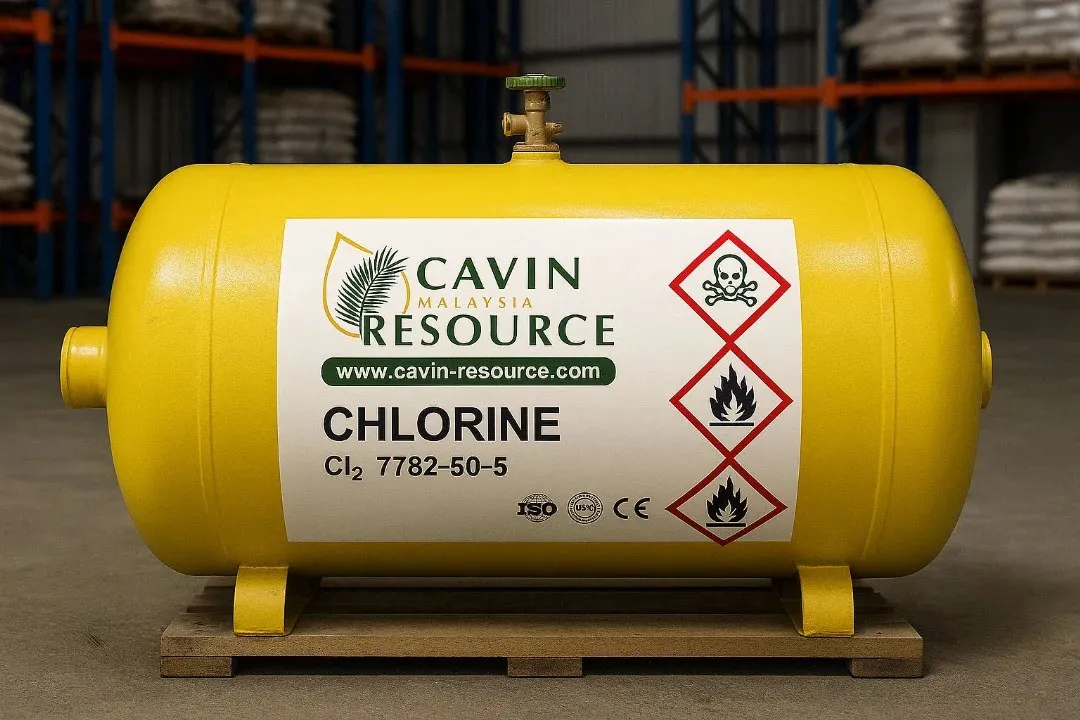
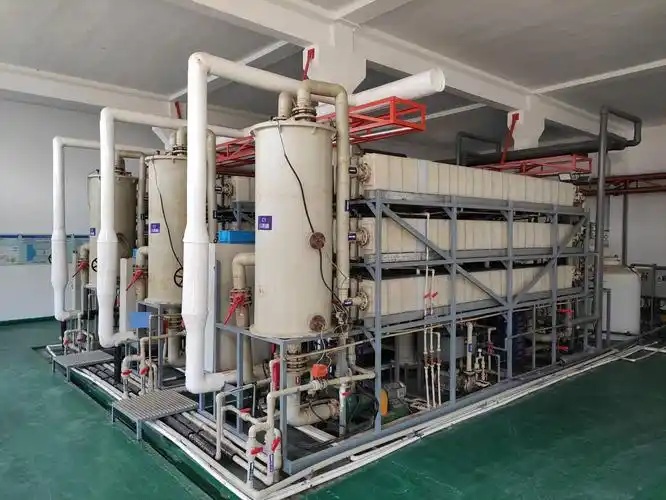
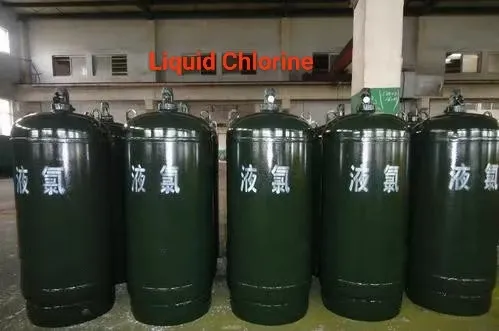
Liquid chlorine is an irreplaceable core raw material for PVC resin, pesticide intermediate, pharmaceutical and industrial disinfection industries. Many small-scale chlor-alkali projects adopt outdated low-pressure refrigeration liquefaction technology, which brings high power consumption, unstable chlorine purity and hidden leakage risks.
With 20 years of chlor-alkali equipment R&D and manufacturing experience, Chlory provides integrated liquid chlorine production matching units based on ion membrane electrolysis core technology. The whole set of skid equipment can stably produce ≥99.5% high-purity liquid chlorine, and co-produce caustic soda, hydrochloric acid and sodium hypochlorite at the same time to balance project income against single chemical market price fluctuation.
The production line covers the entire process from raw salt, water, and electricity to ionolysis membrane electrolysis for chlorine gas, chlorine gas treatment, and the storage and filling of finished liquid chlorine. It is widely used in municipal water treatment, chemical processing, PVC manufacturing, pharmaceutical intermediates, metallurgy, pulp and paper, and pesticide production.
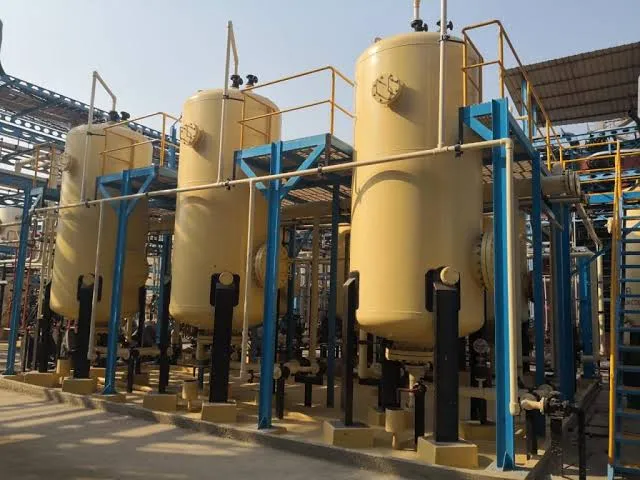
Ion Membrane Chlor-Alkali Whole Plant Technical Overview
Ion membrane electrolysis is the globally recognized clean mainstream process for chlor-alkali production, completely replacing polluting mercury electrolysis and high-waste diaphragm process. Our complete liquid chlorine supporting line takes industrial crude salt as raw material, generates chlorine, hydrogen and liquid caustic soda through electrolysis, and realizes chlorine purification, drying, compression and low-temperature liquefaction through matched post-treatment units to obtain finished liquid chlorine products.
All production links are connected to a unified DCS distributed control cabinet, realizing 24-hour unattended stable operation, effectively reducing manual operation errors and safety hazards in chlorine treatment sections.
Co-Produced Chemicals & Corresponding Industrial Uses
One set of production line can output multiple finished chemicals to cover diversified downstream customer demands:
|
Product |
Standard Indicator |
Main Downstream Application |
|
Liquid Chlorine |
Purity ≥99.5% |
PVC synthesis, pesticide raw material, pharmaceutical intermediate, industrial disinfection raw material |
|
32%/50% Liquid Caustic Soda |
Low salt residue ≤60ppm |
Papermaking, textile mercerization, alumina smelting, daily chemical soap base |
|
≥98% Solid Caustic Flake |
Low impurity content |
Fine chemical synthesis, mineral processing |
|
31-33% High-Purity Hydrochloric Acid |
No heavy metal residue |
Metal pickling, oil well acidification, chemical raw material preparation |
|
15% Sodium Hypochlorite |
Stable available chlorine |
Factory workshop disinfection, cooling water anti-biofouling, municipal sewage sterilization |
|
High-Purity Hydrogen Gas |
Low alkaline mist |
HCl synthesis fuel, steam heating, fine chemical hydrogenation reaction |
Complete Process Units & Step-by-Step Production Flow
The liquid chlorine production supporting system consists of 9 independent process sections, each equipped with special anti-corrosion materials and real-time monitoring sensors to avoid chlorine leakage and pipeline blockage.
Main process steps:
Step 1 — Brine Electrolysis Saturated brine undergoes electrolysis in an ion membrane electrolytic cell, producing chlorine gas at the anode, hydrogen gas at the cathode, and caustic soda (sodium hydroxide) as a byproduct.
Step 2 — Chlorine Gas Drying and Purification Wet chlorine gas from electrolysis enters the drying tower and is counterflowed with 96%~98% concentrated sulfuric acid to remove moisture. Chlorine moisture content is controlled to be below 0.005%. Acid mist is removed by an acid mist collector.
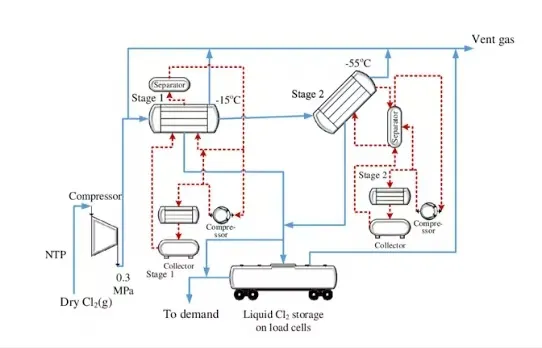
Step 3 — Chlorine Gas Compression After drying, the chlorine gas is pressurized by a chlorine compressor (liquid ring or screw type) to the required liquefaction pressure.
Step 4 — Chlorine Liquefaction The compressed chlorine gas enters the chlorine liquefier—a shell-and-tube heat exchanger where chlorine passes through the tube side and refrigerant through the shell side. Through cooling and pressurization, chlorine gas condenses into liquid chlorine. Liquefaction methods can use high temperature and high pressure, medium temperature and medium pressure, or low temperature and low pressure.
Step 5 — Gas-Liquid Separation The gas-liquid mixture exiting the liquefier enters the separator; liquid chlorine is collected from the bottom, and uncondensed tail gas (containing nitrogen, oxygen, carbon dioxide, and hydrogen) is discharged from the top.
Step 6 — Liquid Chlorine Storage and Filling Liquid chlorine is sent into the intermediate tank, then transferred to the liquid chlorine storage tank (low-temperature storage, temperature -10°C~-30°C). The filling system uses PLC programmable logic control to achieve automatic weighing and filling, and is equipped with logic interlock control.
Core Process Unit Detailed Introduction
|
Serial No. |
Process Section |
Practical Function Description |
|
1 |
Raw Salt Dissolving & Primary Brine Purification |
Mix crude industrial salt with recycled light brine to prepare saturated brine; remove calcium and magnesium impurities via precipitation to prevent membrane scaling |
|
2 |
Chelated Resin Secondary Refining Tower |
Deep filter trace metal ions, control total impurity content below 20ppb, extend ion membrane service life to over 12 years |
|
3 |
Zero-Gap Ion Membrane Electrolyzer (Core) |
Electrolyze refined brine under DC power to separate crude chlorine, hydrogen and 32% liquid alkali |
|
4 |
Light Brine Dechlorination Recycling Unit |
Recycle residual brine after electrolysis, eliminate free chlorine and send back to salt dissolving tank to save raw salt cost |
|
5 |
Chlorine Cooling, Washing & Drying Tower |
Remove water vapor and brine mist in crude chlorine, prevent corrosion of subsequent compression and liquefaction equipment |
|
6 |
Titanium Chlorine Compressor Unit |
Compress dry chlorine to set pressure, send to liquefaction heat exchange system |
|
7 |
Low-Temperature Chlorine Liquefaction Skid |
Cool compressed chlorine to form liquid chlorine, separate non-condensable tail gas for sodium hypochlorite preparation |
|
8 |
Graphite HCl Synthesis Furnace (Matching) |
Use excess hydrogen and tail chlorine to synthesize 31-33% hydrochloric acid |
|
9 |
Multi-Effect Evaporation & Caustic Flaking Unit |
Concentrate dilute liquid alkali into medium-concentration alkali or solid caustic flakes according to order demand |
Linear Production Flow Route
Raw Industrial Salt → Saturated Brine Preparation → Primary Precipitation Purification → Resin Deep Refining → Ion Membrane Electrolysis
- Anode output crude chlorine → cooling & sulfuric acid drying → titanium compression unit → low-temperature liquefier → finished liquid chlorine storage tank
- Cathode output hydrogen gas → washing & pressurization → HCl synthesis furnace or boiler fuel
- Cathode generated 32% NaOH solution → direct filling / multi-effect evaporation concentration / solid flake forming
Core Electrolysis Chemical Reaction Principle
The cation exchange membrane only allows sodium ions to pass through, blocking cross-reaction between chlorine and alkali to guarantee high purity of chlorine products:
- Total reaction: 2NaCl + 2H₂O = 2NaOH + Cl₂↑+ H₂↑
- Anode oxidation: 2Cl⁻ - 2e⁻ = Cl₂↑
- Cathode reduction: 2H₂O + 2e⁻ = H₂↑+ 2OH⁻
Unique Advantages Of Our Liquid Chlorine Liquefaction Equipment
Compared with traditional low-pressure deep refrigeration liquefaction equipment, our high-pressure medium-temperature liquefaction matching unit has obvious cost and safety advantages for chemical plant investors.
1. Lower Comprehensive Power Consumption
Adopt zero-pole distance titanium coated anode electrolyzer to reduce cell voltage; the high-pressure liquefaction process avoids ultra-low temperature refrigeration units, cutting overall plant power consumption by about 29% compared with old liquefaction technology. The DC power consumption per ton of caustic soda is controlled at around 2000 kWh, greatly reducing long-term electricity expenditure.
2. Complete Multi-Layer Safety Protection For Chlorine System
Chlorine pipeline, compressor and liquefier all adopt double-layer sealing design, equipped with real-time chlorine concentration leakage detectors. Once abnormal gas overflow is detected, the system automatically triggers interlock shutdown, and the tail gas pipeline is connected to sodium hypochlorite absorption reactor to avoid toxic gas emission accidents. Dual safety valve configuration is adopted on liquid chlorine storage and delivery pipelines, allowing online inspection and replacement without stopping full production.
3. High Purity Finished Liquid Chlorine, Wide Downstream Adaptability
After multi-stage washing and concentrated sulfuric acid deep drying treatment, the water content in chlorine gas is extremely low, and the finished liquid chlorine purity stably reaches more than 99.5%. No extra purification treatment is required for PVC and pesticide production, which can directly meet high-end synthesis raw material standards.
4. Full Automatic DCS Centralized Control
All parameters such as electrolytic current, chlorine pressure, liquefaction temperature and liquid level are displayed on one control screen. The system can automatically adjust compressor load and refrigeration capacity according to electrolysis chlorine output, realizing unattended operation, only 1-2 on-duty staff are required for the whole workshop.
5. Corrosion-Resistant Long Service Life Configuration
All parts in contact with chlorine, brine and concentrated alkali are made of titanium alloy, nickel 201, Hastelloy alloy and FRP anti-corrosion materials. Core consumable ion membrane normal service life exceeds 12 years, reducing frequent shutdown maintenance losses caused by equipment corrosion damage.
6. Modular Skid Design, Short Factory Construction Cycle
Small and medium-capacity liquid chlorine supporting units are pre-assembled and wired in the factory workshop. After being transported to the customer’s plant, only raw salt pipelines, power supply and circulating water need to be connected, and trial production can be started within 3-7 days without complicated on-site welding and assembly work.
Standard Ion Membrane Electrolyzer Model Parameters
We provide BSH-H series electrolyzers as core equipment, and design exclusive liquefaction supporting skids according to customer daily liquid chlorine output requirements.
|
Model No. |
Effective Electrode Area |
Normal Current Density |
Max Allowable Current Density |
Circulation Mode |
Fastening Structure |
|
BSH-H 2.7 |
2.7 m² |
4.5~5.5 kA/m² |
6 kA/m² |
Natural circulation |
Hydraulic locking |
|
BSH-H 2.9 |
2.9 m² |
4.5~5.5 kA/m² |
6 kA/m² |
Natural circulation |
Screw locking |
Matching Complete Equipment List (100,000 Ton Annual Caustic Project Reference)
This set of configuration covers all equipment required from brine input to liquid chlorine finished product output, convenient for customers to carry out project budget planning:
|
Equipment Name |
Custom Specification |
Manufacturing Material |
Core Function |
|
Ion Membrane Electrolyzer |
2.7~3.3㎡single cell |
Titanium + nickel + imported ion membrane |
Core brine electrolysis to generate crude chlorine |
|
Primary Brine Filter |
Custom flow rate |
Carbon steel lined FRP |
Remove large particle impurities in crude brine |
|
Chelated Resin Purification Tower |
Three towers series connection |
Stainless steel 316L |
Deep removal of calcium and magnesium ions |
|
Chlorine Scrubbing & Drying Tower |
Custom size |
PVC + FRP |
Remove water mist and brine from crude chlorine |
|
Titanium Chlorine Compressor |
Corrosion resistant customized model |
Titanium alloy |
Press dry chlorine for liquefaction |
|
Screw Chlorine Liquefaction Unit |
High-pressure medium temperature type |
Nickel heat exchange tube |
Cool compressed chlorine into liquid chlorine |
|
Liquid Chlorine Storage Tank |
Pressure vessel customized |
Carbon steel lining anti-corrosion layer |
Temporary storage of finished liquid chlorine |
|
Multi-Effect Falling Film Evaporator |
3/4 effect optional |
Nickel 201 alloy |
Concentrate dilute liquid caustic soda |
|
Graphite HCl Synthesis Furnace |
Integrated three-in-one type |
Impregnated graphite |
Produce qualified hydrochloric acid from tail chlorine |
|
15% Sodium Hypochlorite Reactor |
Skid mounted integrated |
Titanium + FRP |
Absorb excess tail chlorine to avoid emission |
|
Full Set DCS Control System |
Custom monitoring module |
Industrial electrical components |
Central automatic control of whole process |
Customized Service Support Scope
We do not sell fixed standard production lines only, all links support personalized adjustment according to customer project conditions:
- Production capacity: Annual caustic output from 10,000 tons to 1 million tons can be matched with corresponding liquid chlorine liquefaction skids
- Product proportion: Adjust the output ratio of liquid chlorine, hydrochloric acid and sodium hypochlorite through DCS parameter setting
- Plant layout: Design equipment layout according to customer factory building area, height and local power grid voltage
- Control mode: Optional local PLC control or full-process DCS centralized automatic control
- Compliance documents: Provide pressure vessel inspection reports, material test certificates and environmental assessment supporting materials for local industrial filing
Why Choose Chlory As Your Liquid Chlorine Production Line Supplier
-
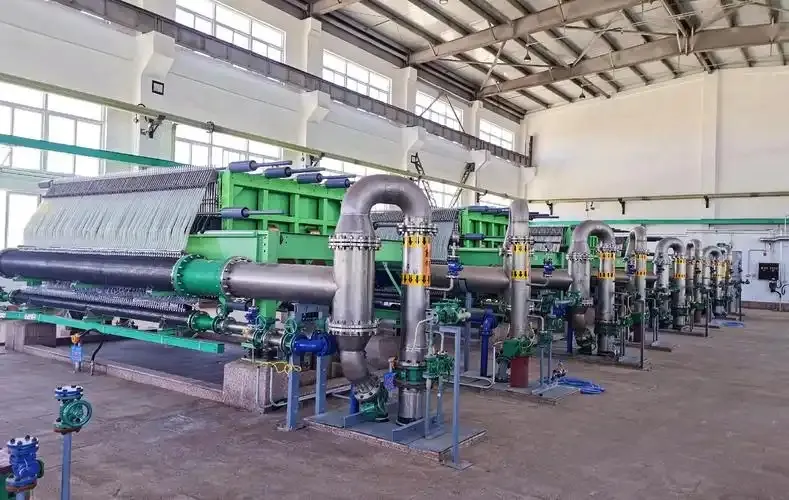 Real Equipment Manufacturer, Not Trading Agent We own independent
processing workshop and chemical engineering design team, 20 years focused
on chlor-alkali electrolysis and chlorine post-treatment equipment
development, all core components self-produced to control delivery cycle
and product quality.
Real Equipment Manufacturer, Not Trading Agent We own independent
processing workshop and chemical engineering design team, 20 years focused
on chlor-alkali electrolysis and chlorine post-treatment equipment
development, all core components self-produced to control delivery cycle
and product quality.
- One-Stop EPC Turnkey Service Cover brine purification scheme design, electrolyzer manufacturing, chlorine liquefaction unit assembly, on-site installation guidance and operator training, no need for customers to coordinate multiple equipment suppliers separately.
- Reserved Expansion Interface For Later Capacity Upgrade All standard liquefaction skids and electrolyzer frames reserve expansion interfaces. If customers need to expand liquid chlorine output in the later stage, only add electrolytic modules and compressors, without replacing the whole set of equipment, saving secondary investment cost.
- Global Overseas After-Sales Engineers We arrange professional chemical equipment engineers to overseas project sites for commissioning, regular maintenance and fault troubleshooting, not only remote online guidance. Stable spare parts supply channel ensures continuous factory production.
- Full Safety Design For Chlorine Hazardous Process We have accumulated rich experience in chlorine liquefaction safety design, all pipelines, storage tanks and reaction units comply with international hazardous chemical equipment standards, effectively reducing safety management pressure of factory operation teams.
Conclusion
For chemical park investors and PVC, pesticide factory owners who need self-produced high-purity liquid chlorine, Chlory’s ion membrane matched chlorine liquefaction production line is a stable, low-consumption and safe long-term production solution. The modular equipment is suitable for small startup projects and large-scale million-ton chlor-alkali integrated plants, with fully customizable output and product proportion to adapt to regional chemical market demand.
If you provide your planned annual production volume, factory building drawing and local industrial salt index, our engineering team will draw exclusive process layout diagram and detailed cost budget for free within 24 working hours.
Boasting 25 years of professional industry experience in production and supply, Chlory factory delivers premium,cost-effective chemical products with reliable quality. Equipped with fully automatic production systems and scientific modular production line design, we achieve stable output, high efficiency and low energy consumption while strictly complying with industrial standards. Different from ordinary manufacturers, Chlory provides flexible customized services tailored to diverse customer needs on product specifications, packaging and solutions. With direct factory pricing and optimized production processes, we help clients cut procurement costs and obtain high-quality, stable chemical supplies with comprehensive professional support.