Overview
This 10 ton per day sodium hypochlorite plant is built on ion-exchange membrane brine electrolysis, engineered for steady, large-volume on-site NaClO manufacturing. Rated capacity: 10 ton/day sodium hypochlorite liquid @12% concentration; concentration can be smoothly adjusted from 5% up to 15% according to production schedule.
This model targets mid-to-large operators who consume high volumes of bleach or disinfectant every week. Many chemical formulators, big municipal water plants and industrial wastewater facilities struggle with unreliable bulk bleach supply, steep ocean freight, port delays and heavy chemical import duties. Instead of arranging repeated bulk tanker deliveries, this integrated skid system lets you make your own high-titer sodium hypochlorite locally from standard industrial salt, fresh water and grid power.
At the 12% setpoint, the plant hits its designed 10 ton daily liquid output. Operators can dial down to 5% dilute disinfectant for continuous water disinfection, or ramp concentration toward 15% for concentrated stock that reduces storage tank footprint and shipping needs for downstream transfer. No extra electrolyzer modules are required for this concentration adjustment.
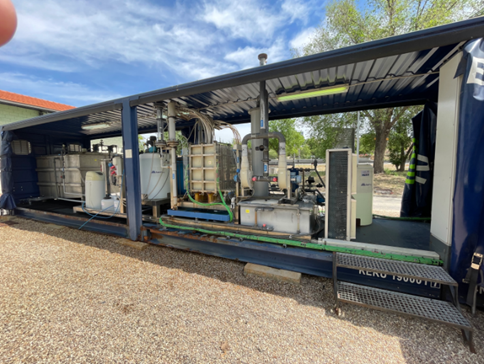
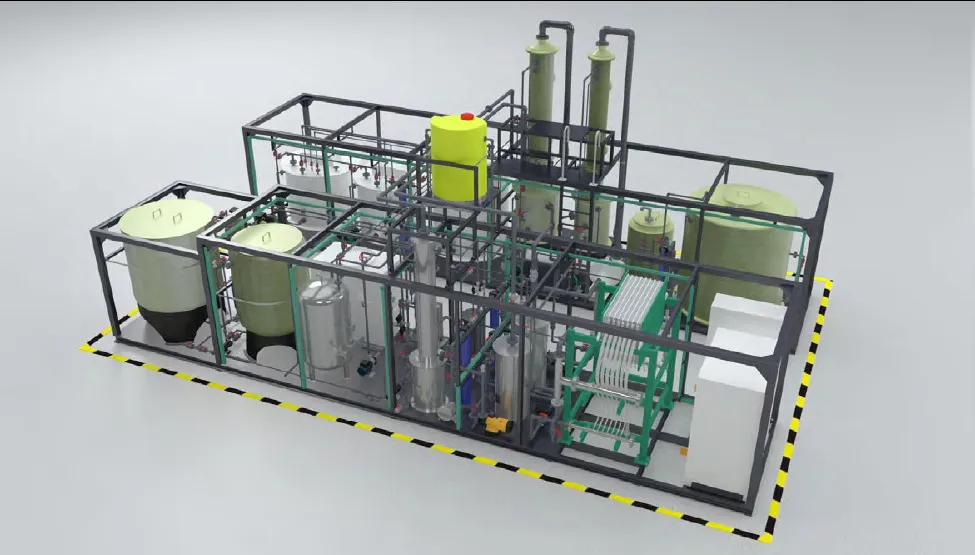
The whole process assembly is pre-fabricated on heavy-duty skids. Civil works, power distribution, salt feeding and tank foundations are prepared on site in advance. Our commissioning team normally completes startup, calibration and operator handover within 3–5 working days. Containerized modular layout is available for sites with limited building space or temporary project sites.
How It Works
The production line runs closed-loop automatic circulation, split into six standard continuous processing sections. Online sensors track key parameters at every stage to stabilise available chlorine strength.
- Saturated Brine Preparation Unit: Industrial salt feeds into the dissolving tank; fresh water is added automatically by level transmitters. Agitators maintain 25% saturated brine. Low brine level triggers auto salt and water replenishment. We accept salt purity ≥89%, so locally sourced mineral salt or sea salt can replace costly high-grade refined salt.
- Two-stage Precision Filtration Section: Saturated brine passes primary coarse filtration then fine polishing filtration. This removes suspended solids and calcium-magnesium precipitates, protecting electrolyzer membranes and electrodes from scaling and premature wear.
- Constant Flow Brine Dosing & Buffer: Purified brine flows into buffer vessels. Flow meters send live readings to the PLC cabinet, and metering pumps deliver stable, regulated brine flow into each bank of electrolytic cells.
- Ion Membrane Electrolysis Core Reaction: Brine enters sealed ion-exchange membrane electrolyzer stacks. High-efficiency digital rectifiers supply stable DC power to drive electrolysis. The ion membrane separates anode and cathode chambers: chlorine releases at the anode, caustic soda forms at the cathode. Both streams circulate fully inside the closed absorption tower and react to form high-concentration sodium hypochlorite. Hydrogen by-product is collected via sealed piping, diluted and safely vented outdoors with full explosion-proof interlocks.
- Concentrated Liquid Storage & Automatic Dosing: Fresh NaClO solution flows into corrosion-resistant storage tanks fitted with level alarms and temperature control. Temperature management slows hypochlorite decomposition and preserves available chlorine shelf life. The system supports linkage with external residual chlorine analysers for automatic dosing loops in water treatment pipelines.
- Automatic Online Pickling Maintenance Loop: Independent acid-wash piping is built into the package. When carbonate scaling reduces electrolysis efficiency, the PLC initiates scheduled pickling cycles. Dilute hydrochloric acid circulates through cell stacks to dissolve scale. Manual disassembly of electrolysis modules is not required, cutting routine maintenance labour.
Core Specs
| Specification | Detail |
|---|---|
| Rated daily output | 10 ton/day sodium hypochlorite liquid @ 12% concentration |
| Adjustable concentration range | 5% ~ 15% NaClO |
| Fixed daily available chlorine | 1,200 kg/day |
| Core technology | Ion-exchange membrane brine electrolysis |
| Raw materials | Industrial salt (NaCl ≥89%), fresh water, electricity |
| Standard consumption | ~2 kg salt, ~2.5 kWh DC power per kg available chlorine |
| Control system | PLC + touch screen, fully automatic, alarm logging & remote access |
| Wetted materials | CPVC piping, 316L stainless steel, fluorine rubber gaskets |
| Layout | Heavy-duty integrated skid mounted; modular containerized option |
| Floor space | 100 ㎡ |
| Unit weight | 5 ton |
| Warranty | 12 months full package; extended warranty for ion membrane stacks |
| Field support | On-site commissioning, operator training, 24/7 remote troubleshooting, regional service in Africa, Middle East & Southeast Asia |
Concentration & Liquid Output Table (Fixed 1200 kg available chlorine / day)
| NaClO Concentration | Daily Liquid Output | Hourly Liquid Output | Typical Use Case |
|---|---|---|---|
| 5% | 24,000 kg/day (24 TPD) | 1000 kg/h | Municipal raw water disinfection, low-strength sanitiser |
| 8% | 15,000 kg/day (15 TPD) | 625 kg/h | General industrial wastewater disinfection |
| 10% | 12,000 kg/day (12 TPD) | 500 kg/h | Standard bleach intermediate stock |
| 12% | 10,000 kg/day (10 TPD) | 416.7 kg/h | ✅ Rated design condition |
| 15% | 8,000 kg/day (8 TPD) | 333.3 kg/h | High-concentration stock, minimise storage volume |
Note: Salt and DC power consumption stay nearly unchanged across all concentration settings, because consumption is calculated against available chlorine production, not liquid volume. Higher concentration means less total liquid output; lower concentration yields larger liquid flow.
OPEX Breakdown (Operating Expense)
This OPEX table is calculated for the rated running condition: 10 TPD @12% NaClO (1200 kg available chlorine per day). Actual daily cost fluctuates based on local salt price, electricity tariff, water charge and labour arrangement. Consumption stays consistent when shifting between 5–15% modes, only finished liquid volume changes.
表格
| OPEX Item | Consumption (Rated: 10 TPD @12% NaClO) | Notes |
|---|---|---|
| Industrial salt (≥89% NaCl) | ~2400 kg/day | Main feedstock; compatible with local sea salt / mineral salt |
| DC electricity | ~3000 kWh/day | DC power for electrolysis stacks only; auxiliary pumps, PLC, cooling and lighting add extra AC load |
| Process water | ~12–14 m³/day | Brine preparation, filter backwash, periodic pickling and tank top-up |
| Pickling chemical (dilute HCl) | Low, intermittent consumption | Auto pickling runs on scheduled cycles, not continuous feed |
| Labour | 1 dedicated shift operator | Automatic operation; one trained operator supervises the unit, logs data and responds to alarms. No round-the-clock manual attendance required, though 24h shift cover can be arranged for continuous plant operation |
| Consumable spares | Planned annual budget | Ion exchange membranes, gaskets, filter cartridges, pump mechanical seals, rectifier spare parts. Long service cycle, predictable annual spend |
| Maintenance & calibration | Routine scheduled service | Monthly sensor calibration, visual leak inspection, quarterly safety interlock test, annual electrolyzer overhaul |
| Site overhead | Site dependent | Safety permits, waste handling, tank inspection, local compliance, insurance and site management fees |
Quick OPEX tip for your project
We prepare a custom OPEX and payback sheet after receiving your local salt price, electricity rate, daily operating hours and preferred running concentration. We also compare the full landed cost of purchased bulk sodium hypochlorite including freight, customs, demurrage and chlorine loss from degradation during transit. For large-volume consumers, the payback period is often much shorter than smaller skid units because bulk logistics premiums scale higher with consumption.
Where to Use This 10 TPD NaClO Plant
This mid-capacity line suits facilities with steady, high daily disinfectant demand:
- Medium & large daily chemical factories manufacturing household bleach, laundry sanitiser and surface disinfectant
- Regional municipal water treatment plants for town and city tap water disinfection
- Large industrial wastewater treatment facilities for final effluent disinfection before discharge
- Thermal power plants, refineries and petrochemical sites for circulating cooling water algae and biofouling control
- Pharmaceutical factories for disinfection raw material preparation
- Large mining complexes, agricultural chemical sites and industrial zones where bulk chemical supply chains are unstable or costly
Why Choose This Unit Over Bulk Bleach Delivery
Buyers running this scale of consumption feel the supply and cost pain of bulk bleach most acutely. This system removes many of those headaches:
- Eliminate repeated bulk tanker orders, freight surcharges, port congestion and customs clearance delays
- Flexible concentration production: switch between dilute 5% disinfectant and 15% high-strength stock without adding equipment
- Automated maintenance with auto pickling, reducing cell stripping and manual cleaning downtime
- Full safety package: closed absorption, hydrogen dilution and safe venting, level, temperature and pressure interlock alarms
- Stable, forecastable OPEX tied to local salt and power, insulating you from volatile chemical market pricing and logistics spikes
- Easy scaling path: we offer larger BSHH series models up to 250 TPD if your bleach demand grows further
Frequently Asked Questions
Q: Can this plant run on local low-grade African sea salt or mineral salt?
A: Yes. The requirement is only ≥89% NaCl purity. You do not need expensive 95%+ refined salt. We recommend a simple brine quality test before final order confirmation.
Q: What changes when I run at 15% versus the rated 12%?
A: The available chlorine output remains fixed at 1200 kg/day. If you set to 15%, daily liquid output drops to 8 TPD. If you run at 5%, liquid output rises to 24 TPD. We can provide a full flow curve for your preferred operating point.
Q: Do I need two separate systems if I need both 5% disinfectant and 12% bleach stock?
A: No. The PLC enables stepless concentration adjustment across 5% to 15%. One production line handles both dilute disinfection feed and high-concentration stock production.
Q: How long is commissioning after shipment arrives?
A: Provided civil foundations, power distribution, salt silo and water piping are ready on site, our field engineers complete commissioning, safety test and operator training within 3–5 working days. Containerized versions cut site construction work significantly.
Q: Are there by-products from electrolysis?
A: The process generates chlorine gas, caustic soda, hydrochloric acid and sodium chlorite alongside sodium hypochlorite. These by-products can be reused inside your plant or sold separately if your site holds the correct permits.
Q: Is the OPEX number fixed?
A: Consumption per kg available chlorine stays stable under normal operating conditions. Final cost varies by local utility pricing and salt cost, and will shift slightly if you run continuously at 5% or 15%. Send us your local tariff data and we prepare custom OPEX and payback calculation.
Get Quote & Operation Cost Calculation
Send your local salt price, electricity tariff, planned daily operating hours and target concentration (5% / 12% / 15%). We will send a formal quotation, layout drawing, full OPEX breakdown and simple payback estimate for your site.