
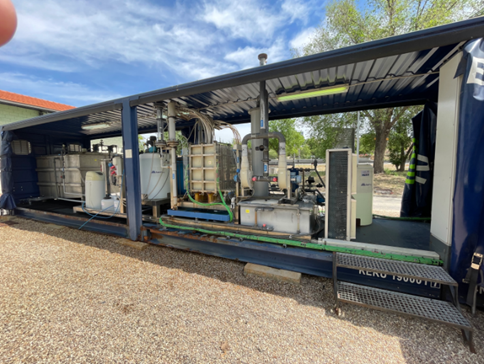
1 TPD sodium hypochlorite plant Overview
This 1 ton per day sodium hypochlorite plant is built around ion-exchange membrane brine electrolysis, designed to run on-site and produce stable 12% to 15% sodium hypochlorite stock solution.
Many buyers in Africa and other remote markets struggle with supply delays, high freight and import restrictions when buying bulk 15% bleach from chemical suppliers. This small skid unit solves that problem: you make your own high-titer NaClO right at your site, using regular industrial salt, tap water and grid power.
We set this model for 1 TPD rated output, with adjustable concentration between 12% and 15%. If you need weaker disinfectant for drinking water lines, the same system can be tuned down to 5% without extra hardware. It comes fully assembled on a skid, so installation only needs water, salt feed and power hookups. Our team usually finishes commissioning in 1–3 working days once site prep is ready.
How It Works
The whole line runs closed-loop automatically with six connected sections. No manual dosing or frequent tank transfers.
- Saturated brine preparation: salt dissolves to 25% brine, liquid level sensors trigger auto refill. We accept salt purity ≥89%, so local sea salt or mine salt can be used instead of expensive refined salt.
- Two-stage precision filtration: removes sediment and calcium-magnesium precipitates that would shorten membrane and electrode life.
- Constant flow buffer and dosing: flow meters feed real-time data to the PLC, metering pump sends steady brine flow to electrolyzer groups.
- Ion membrane electrolysis & absorption: DC rectifier drives the reaction. Anode releases chlorine, cathode generates caustic soda. Both go into a sealed absorption tower and react into 12–15% NaClO. Hydrogen by-product is collected, diluted and vented outdoors under explosion-proof control.
- Concentrated liquid storage and automatic dosing: finished high-strength NaClO flows into corrosion-resistant CPVC / 316L storage tank. Temperature protection slows decomposition, and it can link to online residual chlorine probes for automatic dosing loops.
- Auto pickling loop: when carbonate scaling builds up and drops efficiency, the PLC runs dilute hydrochloric acid circulation. You do not need to pull apart electrolysis cells for cleaning.
Core Specs (1TPD, 12% NaClO)
- Rated daily output: 1 ton / day of 12% sodium hypochlorite
- Concentration range: 5% ~ 15% adjustable, target run at 12–15%
- Core tech: ion-exchange membrane electrolysis
- Raw materials: industrial salt (NaCl ≥89%), fresh water, electricity
- Standard consumption: ~2 kg salt, ~2.5 kWh DC power per kg available chlorine
- Control: PLC + touch screen, fully automatic
- Material contact: CPVC piping, 316L stainless steel for wetted structural parts
- Layout: integrated skid mounted, containerized version optional
- Floor space: 100 ㎡
- Unit weight: 5 ton
- Warranty: 12 months full unit; extended warranty for ion membrane electrolyzer
- Support: remote 24/7 troubleshooting, local technician support available in Africa
| NaClO Concentration | Daily Liquid Output | Notes |
|---|---|---|
| 5% | 2400 kg / day (2.4 TPD) | Low concentration, larger liquid volume |
| 8% | 1500 kg / day (1.5 TPD) | Medium concentration |
| 10% | 1200 kg / day (1.2 TPD) | Common stock concentration |
| 12% | 1000 kg / day (1.0 TPD) | ✅ Rated design condition |
| 15% | 800 kg / day (0.8 TPD) | High concentration, smaller liquid volume |
OPEX Breakdown (Operating Expense)
This operating cost section is critical for buyers comparing on-site generation against delivered bulk bleach. All consumption figures below are calculated based on the rated condition:1 ton/day, 12% NaClO (120 kg available chlorine per day). Actual consumption will shift slightly if you run continuously at 5% or 15%. Final cost depends fully on your local salt price, electricity tariff, water rate and labour cost.
| OPEX Item | Consumption (Rated: 1 TPD @12% NaClO) | Notes |
|---|---|---|
| Industrial salt (≥89% NaCl) | ~240 kg/day | Main raw feedstock; compatible with local sea salt / mineral salt |
| DC electricity | ~300 kWh/day | DC power for electrolysis only; auxiliary pumps, PLC add minor AC power load |
| Process water | ~1.2–1.4 m³/day | For brine preparation, filter backwash and periodic pickling |
| Pickling chemical (dilute HCl) | Low, intermittent use | Automatic pickling runs on scheduled cycles, not continuous consumption |
| Labour | Part-time operator | Fully automatic operation. One operator can manage this unit alongside other plant tasks; 24-hour attendance is not required |
| Consumable spares | Planned annual budget | Ion exchange membrane, gaskets, filter cartridges, pump seals. Long service life, low monthly expenditure |
| Maintenance & calibration | Routine check | Monthly sensor calibration, visual leak inspection, annual overhaul |
| Site overhead | Site dependent | Safety permits, waste handling, tank inspection, local compliance fees |
Where to Use This 1TPD NaClO Plant
This size fits sites that do not need hundreds of tons per day, but still require reliable high-concentration hypochlorite stock.
- Small daily chemical factories making household bleach and laundry sanitiser
- Municipal water stations for town drinking water disinfection
- Wastewater treatment plants for final effluent disinfection
- Power plant circulating cooling water, algae and biofilm control
- Pharmaceutical workshops for intermediate disinfection raw material
- Remote mining camps, agricultural zones and sites with unreliable chemical supply chains
Why Choose This Unit Over Bulk Bleach Delivery
Most customers pick this skid because logistics and customs cost more than the chemical itself, especially inland Africa.
- Cut shipping and risk: no bulk bleach tanker transport, no chemical import permit delays
- Flexible output: switch between high concentration stock for bleach production and dilute disinfectant for water lines
- Low maintenance: auto pickling reduces regular service work
- Safety design: closed absorption, hydrogen dilution and venting, level alarms and over-temperature protection
- Easy to scale: if you later need higher capacity, we have matching larger BSHH models from 2 TPD up to 250 TPD
Frequently Asked Questions
Q: Can I run this plant with local African sea salt?
A: Yes. Our requirement is only ≥89% NaCl, so local sea salt or mineral salt works. You avoid paying premium for 95%+ refined salt. We suggest simple on-site salt quality test before ordering.
Q: Does it need a separate set if I also need 5% low-strength disinfectant?
A: Not required. The PLC adjusts the final concentration continuously from 5% to 15%. One skid covers both use cases.
Q: How long before we can run production after arrival?
A: Once civil work, power, water and salt feed are ready, our engineer completes commissioning within 1–3 days. Containerized version can cut site preparation time further.
Q: What extra chemicals come out besides sodium hypochlorite?
A: The electrolysis process also yields chlorine gas, caustic soda, hydrochloric acid and sodium chlorite as by-products. You can use these on-site or sell them separately if your operation permits.
Q: Do you supply spare parts and training?
A: Spare package is optional. Every handover includes operator training for local staff, plus year-round remote online support.
Get Quote & Operation Cost Calculation
Send us your local salt price, electricity rate, target operating hours and preferred concentration (12% or 15%). We will return a custom quotation and running cost sheet for your site.