
Coastal thermal power plants depend on large volumes of seawater for condenser cooling and circulating water systems. While seawater is abundant and inexpensive, it also carries algae, barnacles, mussels, microbial spores, and other marine organisms that readily attach to pipelines, heat exchangers, and condenser surfaces. The result is persistent marine bio-fouling, which reduces heat transfer efficiency, increases flow resistance, raises energy consumption, and can even cause corrosion, equipment failure, and unplanned downtime.
Traditional anti-fouling methods—manual cleaning, chemical dosing, and ultraviolet sterilization—can address the problem temporarily, but they often come with high hidden costs. For plant managers and operators, the real question is not only whether a technology works, but whether it delivers long-term economic value. This article focuses on the cost savings and ROI of seawater electro-chlorination for coastal thermal power plants.
For a detailed explanation of how seawater electro-chlorination works, see our complete guide: How Seawater Electro-Chlorination Solves Marine Bio-Fouling for Coastal Thermal Power Plants.
1. The Hidden Cost of Marine Bio-Fouling
Marine bio-fouling is not a one-time cleaning problem. It is a dynamic, self-reproducing operational challenge. Once microbial spores and shellfish larvae enter the cooling water system, they can attach to equipment surfaces and multiply rapidly under suitable seawater temperature and flow conditions.
The economic consequences accumulate in several ways:
- Lower heat exchange efficiency. Biological layers act as thermal insulation on condenser and heat exchanger surfaces. To maintain rated power generation, the plant must increase circulating water flow and unit load, which directly raises auxiliary power consumption.
- Higher flow resistance. Bio-fouling narrows pipelines and equipment passages, increasing pressure loss and forcing pumps to work harder.
- Accelerated corrosion and aging. Metabolites and decaying organisms promote electrochemical corrosion, shortening the service life of pipes, pumps, and heat exchange devices.
- Frequent shutdowns for cleaning. Manual cleaning and intermittent chemical treatment require system shutdowns, disrupting continuous power generation and causing lost revenue.
- Environmental compliance risks. Improper chemical dosing can leave residual pollution in coastal waters, creating regulatory and reputational risks.
These factors combine to create a significant, ongoing cost burden that is often underestimated in traditional anti-fouling budgets.
2. Why Traditional Anti-Fouling Methods Are Expensive
Traditional approaches each have cost limitations:
| Method | Main Cost Drivers | Operational Limitations |
|---|---|---|
| Manual cleaning | Labor, shutdown time, equipment wear | Intermittent; bio-fouling rebounds quickly |
| Chemical dosing (liquid chlorine, biocides) | Chemical procurement, transport, storage, safety handling | Hazardous materials; residual discharge concerns |
| Ultraviolet sterilization | Equipment, power, lamp replacement | Limited penetration; ineffective for attached organisms |
| Intermittent high-dose chlorination | Chemical cost, corrosion risk, environmental compliance | Periodic population rebound; unstable protection |
In many plants, the total cost of anti-fouling includes not only direct materials and labor, but also lost generation revenue during shutdowns, increased energy consumption, and premature equipment replacement. These indirect costs can be far larger than the visible cleaning budget.
3. How Electro-Chlorination Reduces Operational Costs
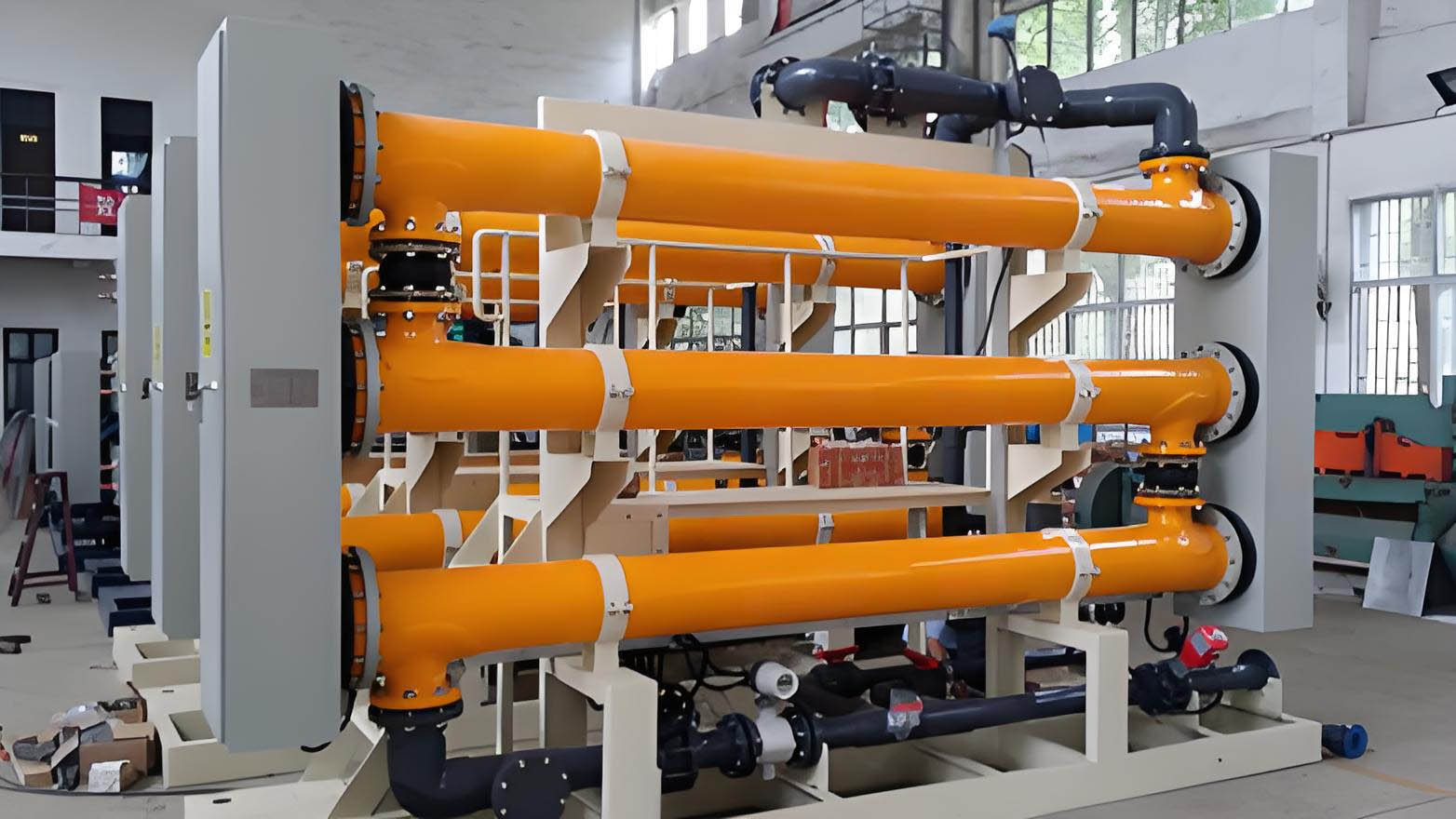
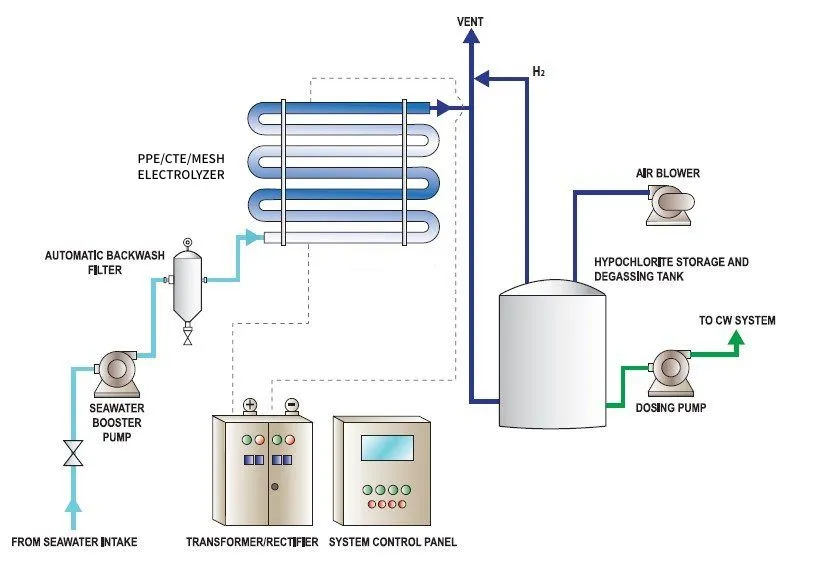
Seawater electro-chlorination is an on-site, on-demand water treatment technology. It uses natural chloride ions in seawater to generate low-concentration active chlorine—mainly hypochlorous acid and hypochlorite ions—directly in the cooling water system. Because the disinfectant is produced on site and dosed continuously at low concentration, it avoids many of the cost drivers of traditional methods.
3.1 Lower Chemical Procurement and Handling Costs
Electro-chlorination eliminates the need to purchase, transport, store, and manually handle liquid chlorine or solid chemical agents. The system only consumes seawater and electricity. This removes:
- Chemical purchase costs
- Transportation and storage costs
- Safety equipment and training costs
- Hazardous material disposal costs
For plants that currently rely on liquid chlorine or commercial biocides, this alone can significantly reduce the annual anti-fouling budget.
3.2 Reduced Downtime and Maintenance
Because electro-chlorination supports 24/7 continuous online operation, it prevents bio-fouling from accumulating in the first place. This reduces the frequency of:
- System shutdowns for manual cleaning
- Heat exchanger and condenser maintenance
- Pipeline blockage removal
- Emergency repairs caused by bio-fouling-related failures
Less downtime means more continuous power generation, which directly protects plant revenue.
3.3 Energy Savings from Maintained Heat Transfer
When condenser and heat exchanger surfaces remain clean, heat transfer efficiency stays high. The plant does not need to increase circulating water flow or unit load to compensate for biological insulation. This lowers auxiliary power consumption and improves overall generation efficiency.
3.4 Labor and Automation Savings
Modern electro-chlorination systems operate automatically with intelligent monitoring. They adjust electrolysis output and dosing volume in real time based on seawater temperature, water flow, and biological activity. This reduces manual intervention, lowers labor costs, and minimizes human operation errors.
4. Quantifying the Savings: Up to 40% Lower Anti-Fouling Costs
Practical application data from multiple power plants shows that seawater electro-chlorination can reduce overall anti-fouling operational costs by nearly 40% compared with traditional chemical treatment.
A simplified comparison for a typical coastal thermal power plant might look like this:
| Cost Category | Traditional Chemical Treatment | Seawater Electro-Chlorination |
|---|---|---|
| Chemical procurement | High | None |
| Chemical transport & storage | High | None |
| Manual dosing labor | Moderate to high | Low (automated) |
| Shutdown cleaning frequency | High | Low |
| Energy penalty from fouling | High | Low |
| Equipment corrosion & replacement | High | Reduced |
| Environmental compliance risk | Moderate to high | Low |
| Estimated annual anti-fouling cost | Baseline | Up to 40% lower |
The exact savings depend on plant size, seawater quality, cooling water flow, and local chemical prices. However, the direction is clear: electro-chlorination shifts anti-fouling from a recurring chemical and labor expense to a low-marginal-cost, automated process.
A Simple ROI Perspective
For a plant spending, for example, $500,000 per year on anti-fouling chemicals, labor, and related maintenance, a 40% reduction would save approximately $200,000 annually. Over a 10-year period, that is $2 million in avoided operating costs—before accounting for additional savings from reduced downtime and extended equipment life.
When lost generation revenue from shutdown cleaning is included, the economic case becomes even stronger.
5. Additional Economic Benefits
Beyond direct cost reduction, seawater electro-chlorination delivers several indirect financial benefits:
- Extended equipment life. By preventing bio-fouling and associated corrosion, the system helps extend the service life of pipelines, pumps, condensers, and heat exchangers.
- Improved operational reliability. Stable anti-fouling performance reduces unexpected failures and improves overall plant availability.
- Environmental compliance. Active chlorine self-decomposes rapidly in natural seawater, avoiding harmful residual accumulation. This helps plants meet marine environmental protection and wastewater discharge standards, reducing the risk of fines or regulatory delays.
- Green brand value. As global environmental regulations tighten, plants that adopt eco-friendly anti-fouling technology can strengthen their green brand image and ESG performance.
6. Conclusion
Marine bio-fouling is a long-standing operational and financial burden for coastal thermal power plants. Traditional anti-fouling methods may appear cheaper at the point of purchase, but their total cost—including chemicals, labor, shutdowns, energy penalties, corrosion, and environmental compliance—is often much higher than expected.
Seawater electro-chlorination offers a fundamentally different economic model. By generating low-concentration disinfectant on site from seawater and electricity, it provides continuous, automated bio-fouling prevention with minimal chemical handling and reduced maintenance. With documented savings of up to 40% in anti-fouling operational costs, it is not just an environmental solution—it is a practical, high-ROI investment for coastal thermal power plants.
For plants pursuing safe, efficient, low-consumption, and environmentally friendly operation, seawater electro-chlorination has become a standard configuration for seawater cooling system treatment. It solves the bio-fouling problem from the source and delivers measurable long-term economic value.