
A groundbreaking ceremony was held on August 26 at the Adams Land & Cattle (ALCC) feedlot south of Broken Bow, Nebraska, marking the official launch of Neogenyx Fuels’ first agricultural renewable natural gas (RNG) project. With a total investment of nearly $300 million, the facility will turn one of the feedlot’s most abundant byproducts — cattle manure — into renewable energy, fertilizer and economic opportunity.
From manure to pipeline-grade gas
The project will deploy eight anaerobic digesters that process feedlot manure as the primary feedstock. The resulting biogas — more than 4,400 standard cubic feet per minute — is upgraded into approximately 1.2 million MMBtu of pipeline-quality renewable natural gas each year. That RNG can be injected into the existing natural gas grid, and in the future it may be converted into bio-LNG for the international shipping industry.
Anaerobic digestion also recovers valuable nutrients — nitrogen and phosphorus — from the manure. Some of these nutrients are reused on-site for agricultural and livestock purposes, while surplus fertilizer products can be made available to farmers across the region.
Emissions savings and local jobs
The facility is expected to avoid nearly 64,000 metric tons of carbon dioxide emissions annually — roughly equivalent to the carbon sequestered by 64,000 acres of U.S. forest in a year. It will also create an estimated 10–15 permanent jobs in the Broken Bow area.
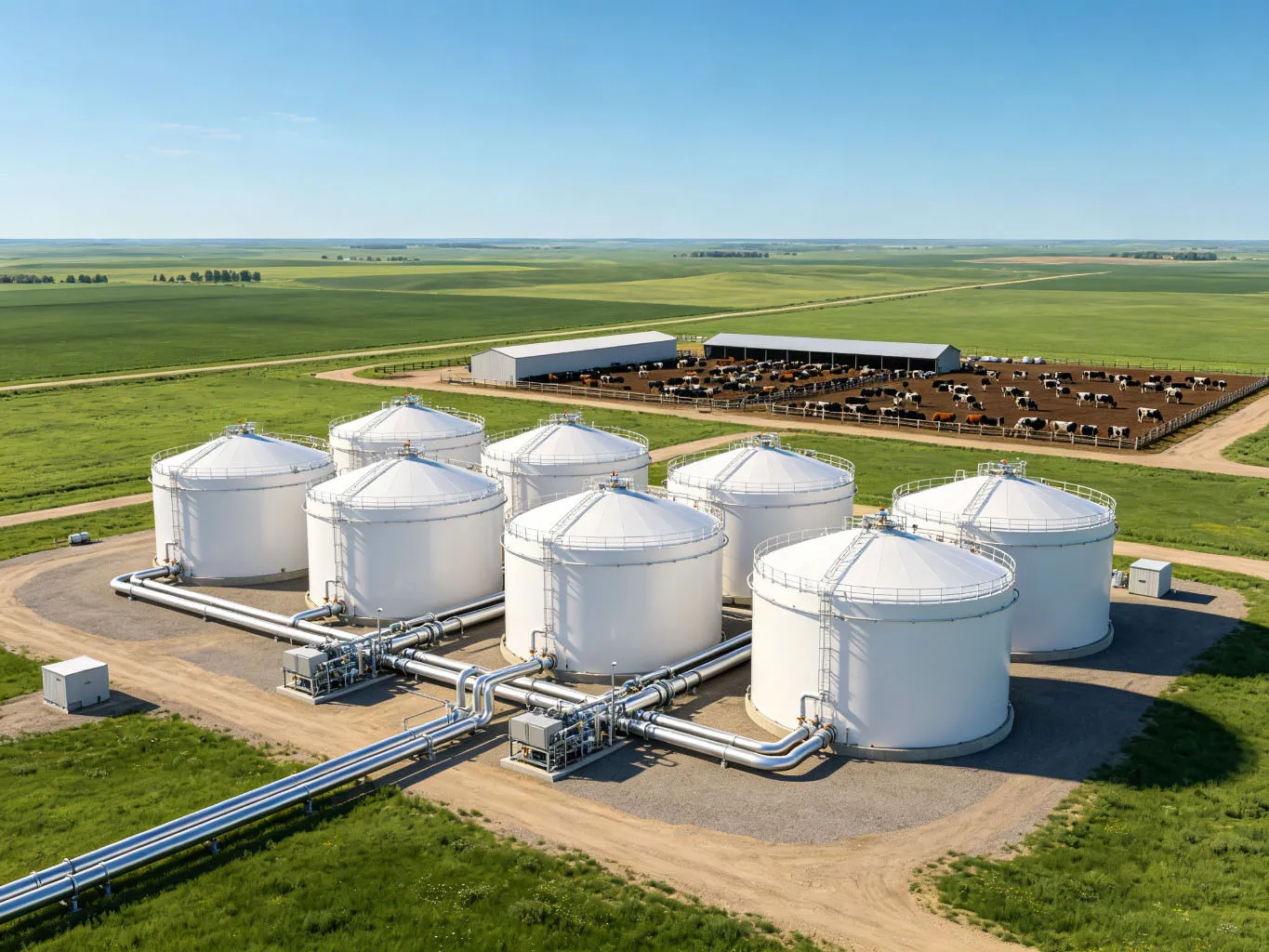
Eight anaerobic digesters will process manure and produce pipeline-grade renewable natural gas.
Part of a broader feedlot transformation
The RNG project is part of a much larger modernization programme at ALCC’s southern feedlot. Starting in 2023, ALCC introduced roller-compacted concrete (RCC) and launched a three-year pen-rebuilding effort in 2025. The RCC upgrade reduces dust, improves pen conditions, and creates the surface needed for the manure-collection system that feeds the digesters. Once complete, the southern feedlot is expected to reach a capacity of approximately 150,400 cattle.
Key facts at a glance
Project snapshot| Project | First agricultural RNG facility for Neogenyx Fuels |
|---|---|
| Location | Adams Land & Cattle feedlot, south of Broken Bow, Nebraska |
| Investment | Approaching $300 million |
| Technology | 8 anaerobic digesters; biogas upgrading |
| Output | ≈ 1.2 million MMBtu pipeline-grade RNG per year |
| CO₂ avoided | ≈ 64,000 metric tons per year |
| Jobs | 10–15 local positions |
| Feedlot capacity | ≈ 150,400 cattle after RCC rebuild |
Industry and state leaders weigh in
Representatives from enterprises, local communities and government officials attended the event.
The project transforms manure — historically a waste requiring disposal — into reliable energy and fertilizer products. Nutrient recovery delivers great value for regional farmers, and the company keeps challenging traditional agricultural boundaries.— Abram Babcock, CEO, Adams Land & Cattle
This project represents a major milestone in state-wide agricultural innovation. Nebraska agriculture has evolved from food production, to food-and-fuel production, and now toward integrated food-fuel-energy development.— Jim Pillen, Governor of Nebraska
This unique demonstration proves American agriculture can effectively participate in global low-carbon energy markets.— Michael Bakas, CEO, Neogenyx Fuels
Room to grow across Nebraska
According to the American Biogas Council (ABC), Nebraska farms produce more than seven million tons of livestock manure each year, and more than 300 farms in the state have biogas development potential. When other organic waste streams — landfill, food waste and wastewater — are included, roughly 400 biogas-related facilities could be built across the state, representing more than $8 billion in economic opportunity. Currently, only two on-farm biogas projects are operating in Nebraska, underscoring the strong demonstrative value of this newly-started project.
Two years in the making
The project has been under development for more than two years. Initial discussions between Adams Land & Cattle and Neogenyx began in January 2024, followed by extensive research, meetings and coordination that led to this week’s groundbreaking.