
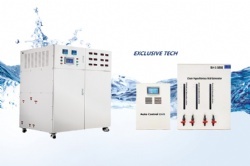
In the food and beverage industry, hygienic production is the core of product safety and brand reputation. Clean-in-Place (CIP) sanitization is an indispensable automated cleaning process for modern production lines, widely used in dairy, juice, and brewery manufacturing. Traditional CIP cleaning relies on chemical disinfectants such as bleach, quaternary ammonium salts, and strong alkaline detergents, which often leave chemical residues, affect product flavor, cause equipment corrosion, and increase wastewater treatment costs. As food safety standards become stricter worldwide, on-site hypochlorous acid (HOCl) generators have become an optimal upgrade solution for food and beverage factory CIP sanitization, achieving efficient, residue-free, eco-friendly, and low-cost line cleaning.
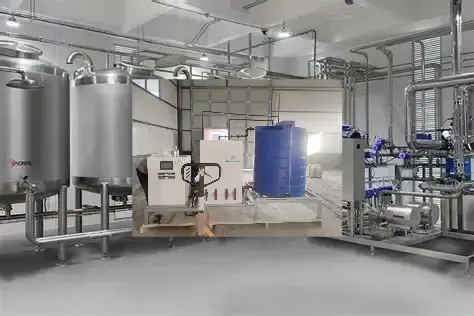
1. Core Challenges of Traditional CIP Sanitization in F&B Production Lines
Dairy, juice, and brewery production lines have extremely high requirements for microbial control and sanitary cleanliness, as residual bacteria, mold, yeast, and organic contaminants can easily lead to product spoilage, shortened shelf life, and unqualified safety inspections. Traditional CIP sanitization methods expose prominent pain points in long-term industrial application:
First, chemical residue risks. Synthetic disinfectants cannot be completely rinsed in conventional CIP cycles, leaving trace chemicals on pipeline inner walls, fermentation tanks, and filling equipment. These residues will mix with raw materials, destroying the original flavor of dairy products, fresh juice, and beer, and even failing food safety testing.
Second, equipment loss and high maintenance costs. Strong acid and alkali disinfectants cause gradual corrosion of stainless steel pipelines, valves, and tank bodies, leading to equipment aging, pipeline blockage, and increased frequency of replacement and maintenance, raising overall operational costs for factories.
Third, environmental and operational hidden dangers. Purchasing, storing, and manually dosing industrial chemicals involves safety risks such as leakage and corrosion. In addition, wastewater containing residual chemicals increases the difficulty and cost of factory sewage treatment, failing to meet green production standards.
Fourth, unstable sterilization effect. The efficacy of traditional disinfectants is easily affected by water temperature, concentration, and cleaning time, resulting in incomplete sterilization and recurrent microbial contamination in production lines.
2. Why HOCl Generator Is the Ideal CIP Sanitization Solution for F&B Lines
Hypochlorous acid (HOCl) is a mild, high-efficiency, and food-grade safe disinfectant. Different from traditional chemical agents, the HOCl generator adopts advanced electrolysis technology, which only uses tap water and edible salt as raw materials to produce high-purity neutral HOCl solution on-site and on-demand. It perfectly adapts to the continuous CIP cleaning cycle of food and beverage factories, solving all pain points of traditional sanitization.
Superior sterilization performance: Neutral HOCl solution with a pH value of 4.5–6.5 has strong oxidative bactericidal ability, which can quickly and efficiently kill common harmful microorganisms in food production, including E. coli, salmonella, mold, yeast, and lactic acid bacteria. It achieves a 99.9% sterilization rate in a short time, thoroughly eliminating microbial contamination risks in pipelines and equipment.
Zero residue and food safety compliance: HOCl is a natural bactericidal substance existing in the human immune system. After completing CIP cleaning and disinfection, it will automatically decompose into water and salt without any chemical residues. It does not affect the flavor, taste, and nutritional value of dairy, juice, and beer products, fully complying with FDA, USDA and global food safety production standards.
Equipment-friendly and low maintenance: The mild neutral HOCl solution will not corrode stainless steel production equipment, pipelines, and sealing parts. It avoids equipment aging and damage caused by acid-base disinfectants, effectively extending the service life of production lines and reducing equipment maintenance and replacement costs.
Cost-saving and sustainable operation: The HOCl generator realizes on-site automatic production, eliminating the cost of purchasing, transporting, and storing bottled disinfectants. The raw materials are only water and salt, with extremely low unit disinfection cost. Meanwhile, the decomposed HOCl wastewater has no pollution, reducing the pressure of factory sewage treatment and realizing green and low-carbon production.
Stable and intelligent operation: Equipped with PLC intelligent control system, the generator can stably output HOCl solution with adjustable concentration (100–500ppm) according to different production line cleaning needs. It can be seamlessly connected with the factory’s automatic CIP system to realize unattended cyclic cleaning and improve production efficiency.
3. Targeted HOCl CIP Sanitization Applications for Dairy, Juice and Brewery Lines
3.1 Dairy Production Line CIP Sanitization
Dairy products such as fresh milk, yogurt, and cheese are rich in protein and lactose, which are extremely easy to breed bacteria and mold. Residual milk dirt in pipelines and fermentation tanks is the main cause of product deterioration. HOCl generator matched with dairy CIP system can thoroughly clean and disinfect milk delivery pipelines, fermentation tanks, sterilization equipment, and filling machines. It effectively removes organic milk residues and kills heat-resistant bacteria, ensuring the freshness and long shelf life of dairy products without changing the pure taste of milk products.
3.2 Juice Production Line CIP Sanitization
Fruit juice products are sensitive to peculiar smells and chemical residues, and mold and yeast contamination are the key problems restricting juice production hygiene. Traditional disinfectants are prone to residual odor, which destroys the fresh fruit flavor of juice. The residue-free and odorless characteristics of HOCl make it very suitable for CIP cleaning of juice extraction pipelines, blending tanks, sterilization lines, and filling equipment. It completely eliminates yeast and mold hidden dangers, maintains the pure flavor of fresh juice, and extends the shelf life of finished juice products.
3.3 Brewery Production Line CIP Sanitization
Beer brewing has strict requirements on microbial control in fermentation links. Harmful bacteria and miscellaneous fungi will affect beer fermentation efficiency, taste, and foam performance. HOCl CIP sanitization is applied to beer fermentation tanks, storage tanks, conveying pipelines, and filling lines, which can efficiently kill miscellaneous bacteria without affecting the activity of brewing yeast. It avoids flavor deterioration, turbidity, and deterioration of beer caused by microbial contamination, ensuring stable and high-quality beer production.
4. Conclusion
With the upgrading of global food safety supervision and the transformation of the food and beverage industry to green production, traditional CIP sanitization methods can no longer meet the high-standard hygienic production needs of dairy, juice, and brewery enterprises. The HOCl generator, with its advantages of high efficiency, safety, zero residue, low cost, and environmental protection, has become a revolutionary upgrade solution for food and beverage factory CIP cleaning. It not only solves the problems of residual pollution and equipment loss in traditional disinfection but also helps enterprises reduce operating costs, improve product quality, and build a safe and green production system.
For food and beverage manufacturers pursuing standardized, intelligent and sustainable hygienic production, replacing traditional chemical disinfection with HOCl on-site generation CIP sanitization will be an inevitable industry trend.