


Sodium hypochlorite (NaClO), commonly known as bleaching water, is a staple oxidant and disinfectant in modern sewage treatment systems. With its strong oxidizing and decolorizing properties, it has become an economical and effective solution for both municipal and hospital wastewater treatment. This article provides a comprehensive analysis of NaClO’s chemical properties, practical applications, dosage specifications, discharge standards and safety precautions, combining the latest industry test data and regulatory requirements to deliver professional, actionable technical guidance.
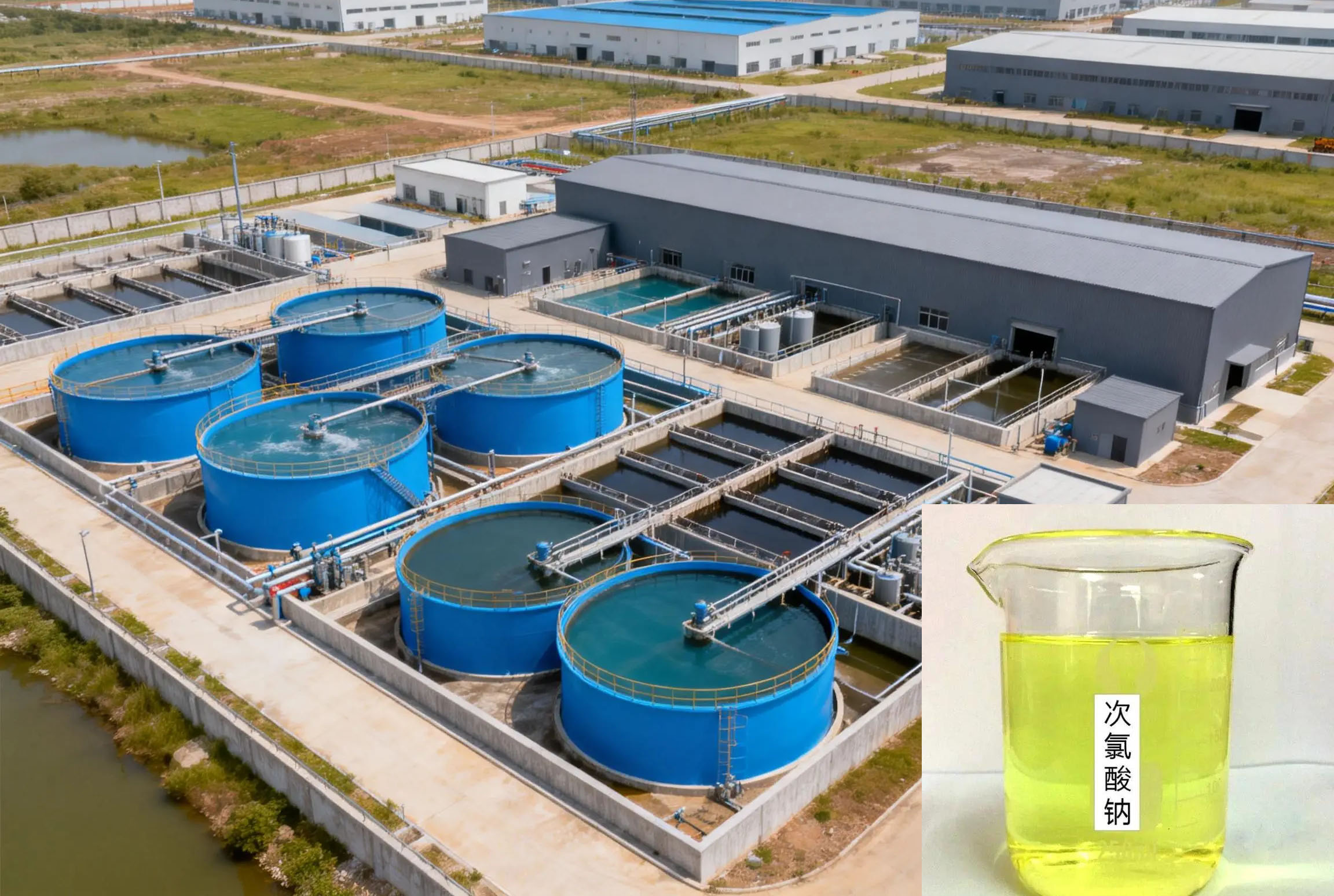
Key Chemical Properties of NaClO
NaClO presents as a pale yellow aqueous solution with a pungent odor, boasting the following core physical and chemical characteristics:
- Molecular Formula: NaClO
- Melting Point: -6℃;Boiling Point: 102.2℃
- Relative Density: 1.10 (water = 1), fully soluble in water
- Commercial Concentration: Typically 10% for water treatment applications
- Core Properties: Strong oxidizability, decolorization, and broad-spectrum bactericidal activity
- Limitations: Chemically unstable; thermal decomposition produces trihalomethanes (THMs) — a class of disinfection byproducts (DBPs) — and elevates water pH levels.
Notably, NaClO is non-toxic and easy to handle in hospital sewage disinfection, with no operational safety risks under standard use, making it superior to many other chlorine-based disinfectants.
Core Application Methods of NaClO in Sewage Treatment
NaClO is dosed directly into wastewater for disinfection and pollutant removal, with three mainstream industrial application methods, each tailored to different water quality conditions and treatment objectives:
1. Chemical Reduction Method
This method uses reducing agents (e.g., sodium sulfite) to convert excess NaClO into non-toxic sodium chloride (NaCl).Advantages: Simple operation and low equipment investment;Key Requirement: Strict control of reducing agent dosage to avoid secondary pollution from under-dosing or over-dosing. It is widely used in municipal sewage treatment plants with stable water quality.
2. Neutralization Method
Acidic substances (sulfuric acid or hydrochloric acid) are added to adjust wastewater pH and reduce the oxidizing activity of residual NaClO.Applicability: Only for wastewater with low NaClO concentration (post-disinfection residual). This method is cost-effective and easy to integrate into existing treatment processes, making it a common choice for small and medium-sized treatment facilities.
3. Electrolysis Method
Electrolysis decomposes NaClO into chlorine gas (Cl₂) and sodium hydroxide (NaOH), achieving rapid removal of excess disinfectant.Advantages: High treatment efficiency and thorough residual removal;Disadvantage: High equipment and operational costs due to energy consumption. It is mainly adopted by large-scale water treatment enterprises and high-standard hospital wastewater systems for advanced treatment.
Discharge Standards for NaClO-Treated Wastewater
Wastewater disinfected and treated with NaClO must comply with strict environmental and public health standards, with thecore regulatory requirementbeing the removal of over 90% of pathogenic microorganisms (e.g., E. coli, fecal coliforms). Additional key standards include:
- Microbial Index: Fecal coliform count must meet local discharge limits (undetectable in high-standard hospital wastewater);
- Physicochemical Index: Ammonia nitrogen, COD and chroma must reach national/international wastewater discharge standards;
- Residual Chlorine: Effluent total residual chlorine should be controlled at 3–5 mg/L for disinfection efficacy, with a daily average discharge limit of 0.5 mg/L to avoid aquatic ecosystem damage;
- pH Value: Maintained at 6.5–8.5 (neutral to slightly alkaline) to prevent environmental harm from extreme pH levels.
All treated wastewater must ensure no ecological or human health risks, adhering to the latest NPDES and local environmental protection regulations.
Multifunctional Roles of NaClO in General Sewage Treatment
NaClO is not just a disinfectant but a multi-purpose water treatment agent, delivering four core functions in municipal and industrial sewage treatment, all driven by its strong oxidizing properties:
1. Broad-Spectrum Disinfection
As a high-efficiency disinfectant, NaClO rapidly inactivates bacteria, viruses, parasites and other pathogenic microorganisms by destroying their cell membranes, proteins and nucleic acids. Disinfection is a critical step in sewage treatment, preventing the spread of infectious diseases and secondary environmental contamination. NaClO’s fast-acting and broad-spectrum activity significantly improves the sanitary safety of reclaimed water and discharged effluent.
2. Oxidative Decomposition of Organic Matter
NaClO reacts with refractory organic pollutants (e.g., phenols, cyanides, sulfides) in sewage, decomposing them into harmless small molecules (CO₂, H₂O, inorganic salts). This effectively reduces wastewater COD and BOD levels, improves biodegradability, and lays a foundation for subsequent biological treatment. It is particularly effective for organic-polluted industrial wastewater (e.g., food processing, printing and dyeing wastewater).
3. Odor and Color Removal
Sewage odor primarily stems from microbial metabolites and organic decomposition products (e.g., hydrogen sulfide, ammonia). NaClO oxidizes these odor-causing substances into non-odorous compounds, eliminating unpleasant smells. Meanwhile, it breaks the molecular structure of color-causing substances (e.g., dyes, humus) via oxidation, achieving efficient decolorization — a key function for treating colored industrial wastewater and black and odorous municipal sewage.
4. Algae Inhibition and Removal
Eutrophication in sewage treatment systems often leads to algal blooms, which reduce water transparency, produce toxic metabolites and disrupt treatment processes. NaClO oxidizes algal cells to inhibit their reproduction and decomposes algal toxins, effectively reducing algae biomass and improving water quality. This function is especially important for sewage treatment plants with natural water bodies (e.g., oxidation ponds) as part of their process.
Special Application of NaClO in Hospital Sewage Treatment
Hospital wastewater contains high concentrations of pathogenic microorganisms, ammonia nitrogen, COD and chroma, requiring targeted treatment. NaClO’s unique advantages make it the preferred disinfectant for hospital wastewater, with test data confirming its exceptional performance:
1. Bactericidal Efficacy and Optimal Dosage
Laboratory tests show that1mL of 10% NaClO solution reacting with hospital wastewater for 1 hour results in undetectable fecal coliforms— far exceeding the standard disinfection requirements for chlorine-based agents. Theeconomical and effective dosageis0.2%–0.4% (v/v)(1–2mL of 10% NaClO per 500mL of hospital wastewater), which not only achieves complete disinfection but also keeps the effluent pH neutral (6.5–7.5) without additional pH adjustment.
For different pollution levels of hospital wastewater, the dosage can be adjusted according to the latest industry standards:
- General hospital sewage: 20–40mg/L (10% NaClO), contact time ≥1 hour, residual chlorine 3–5mg/L;
- Heavily polluted sewage (fecal coliform >5000MPN/L): 80–120mg/L (10% NaClO);
- Infectious disease hospital sewage: 40–80mg/L (10% NaClO), contact time ≥1.5 hours, residual chlorine 6–10mg/L.
2. Pollutant Removal Efficiency
Beyond disinfection, NaClO effectively removes ammonia nitrogen, COD and chroma from hospital wastewater (see Figure 3 for removal efficiency trends). The 0.2%–0.4% dosage achieves standard-compliant ammonia nitrogen removal, with significant reductions in COD and chroma — solving multiple hospital wastewater treatment challenges in a single step. This dual-effect (disinfection + pollutant removal) makes NaClO a cost-effective choice for hospital wastewater treatment.
3. Critical Operational Precautions
Due to NaClO’s chemical properties and the special nature of hospital wastewater, strict adherence to the following precautions is essential to ensure treatment efficacy and safety:
(1) Control of Disinfection Byproducts and pH
NaClO’s thermal decomposition produces THMs (genotoxic and cytotoxic DBPs), and excessive dosing elevates water pH. Mitigation measures:
- Strengthen ventilation in the dosing room and use automatic dosing control systems to avoid manual operation and ensure precise dosage;
- Real-time monitor effluent pH, adjust dosing in a timely manner to prevent excessive alkalinity;
- Perform dechlorination treatment if effluent is discharged directly into surface water bodies to eliminate residual chlorine and DBPs.
(2) Dosage Optimization Based on Water Quality
- For hospital sewage with high chroma and ammonia nitrogen, adjust NaClO dosage according to actual water quality testing results (refer to sodium chlorate dosage standards for extreme cases);
- For disinfection-only applications, follow the hospital sewage disinfection recommended dosage to avoid waste and excessive DBP production.
(3) Safety and Labor Protection
- Operators must wear protective equipment (goggles, gloves, respirators) to avoid direct contact with concentrated NaClO solution;
- Store NaClO in a cool, ventilated area away from heat sources and acidic substances to prevent decomposition and dangerous reactions;
- Regularly calibrate dosing equipment to ensure accurate dosage and treatment consistency.
Conclusion
Sodium hypochlorite (NaClO) is an economical, efficient and versatile agent in sewage treatment, with irreplaceable roles in disinfection, pollutant removal, deodorization and algae inhibition for both general and hospital wastewater. Its advantages — non-toxicity, easy operation, broad-spectrum efficacy and dual disinfection/pollutant removal — make it a mainstream choice for water treatment facilities worldwide.
While NaClO has limitations (e.g., DBP production, pH elevation), these can be effectively mitigated through automatic precise dosing,real-time water quality monitoring and standardized operational procedures. For hospital wastewater treatment, the 0.2%–0.4% optimal dosage balances efficacy, economy and environmental safety, meeting the latest discharge standards.
With the continuous advancement of water treatment technology and the tightening of environmental regulations, NaClO’s application prospects in sewage treatment remain promising. By adhering to best practices and safety guidelines, water treatment enterprises can maximize NaClO’s performance, achieving efficient, cost-effective and environmentally friendly wastewater treatment.