With the rapid development of the global aquaculture industry, environmental protection requirements are becoming increasingly stringent, and the shift from traditional extensive farming to intensive recirculating aquaculture systems (RAS) has become an inevitable trend. In RAS, water quality stability directly determines the survival rate, growth rate, and product quality of aquatic organisms. Disinfection, as a core link to control pathogenic microorganisms, remove harmful substances, and maintain water ecological balance, has been a key focus of aquaculture practitioners. Traditional disinfection methods such as potassium permanganate, ozone, or sodium hypochlorite have drawbacks like unstable efficacy, aquatic organism irritation, or residual hazards. Against this background, hypochlorous acid (HOCl) generators have emerged as a new star in aquaculture disinfection, perfectly matching the needs of RAS with their safety, efficiency, stability, and environmental friendliness. This article explores why hypochlorous acid generators have become the ideal disinfection solution for RAS and the new trends they drive in aquaculture.
1. Core Demands of Disinfection in Recirculating Aquaculture Systems (RAS)
Different from open aquaculture, RAS realizes water reuse through processes such as filtration, aeration, and disinfection, with water circulation rate up to 90% or more. This closed-loop mode puts forward higher requirements for disinfection technology:
-
Safety for Aquatic Organisms: Disinfectants must not irritate or poison fish, shrimp, crabs, and other aquatic products, and must not affect their growth, reproduction, or immune system. Residual disinfectants or by-products must be strictly controlled to avoid endangering human health through the food chain.
-
Efficient Pathogen Control: RAS has high stocking density, and pathogenic microorganisms such as bacteria (Vibrio, Aeromonas), viruses, and parasites are prone to spreading in the closed water environment. Disinfectants must have broad-spectrum bactericidal activity to quickly and effectively inactivate pathogens and prevent disease outbreaks.
-
Stable Water Quality Maintenance: Disinfection should not disrupt the balance of the water ecosystem, especially the activity of beneficial microorganisms (such as nitrifying bacteria) that are crucial for ammonia nitrogen and nitrite removal. It should not cause drastic changes in water pH, dissolved oxygen (DO), or other indicators.
-
Adaptability to RAS Operation: The disinfection system should be easy to integrate with existing RAS equipment (such as filters, aeration devices, and water quality monitoring systems), with simple operation, stable performance, and low operational and maintenance costs.
2. Why Hypochlorous Acid Generators Outperform Traditional Disinfection Methods in RAS
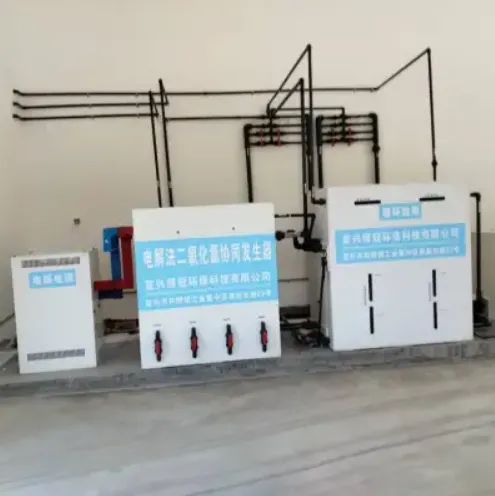
Hypochlorous acid is a weak acid that is naturally present in the human body and has strong biocidal activity. Hypochlorous acid generators produce high-purity HOCl on-site using only tap water, salt, and electricity, which perfectly meets the core demands of RAS disinfection. Compared with traditional methods, their advantages are obvious:
2.1 High Safety, No Residue or Irritation
At the effective disinfection concentration (0.3-1.0 ppm for fish farming, 1.0-2.0 ppm for shrimp farming), hypochlorous acid has no irritating effect on the gills, skin, or digestive tract of aquatic organisms. Unlike sodium hypochlorite (which produces excessive chloride ions and residual bleaching powder) or ozone (which has strong oxidizability and may damage aquatic organism gills), hypochlorous acid decomposes into water and salt after disinfection, leaving no toxic residues. This ensures the safety of aquatic products and complies with global food safety standards for aquaculture.
2.2 Broad-Spectrum and Efficient Disinfection
Hypochlorous acid can quickly inactivate various pathogenic microorganisms in aquaculture water, including Vibrio parahaemolyticus, Aeromonas hydrophila, white spot syndrome virus (WSSV), and ichthyophthirius multifiliis. Its bactericidal rate is 80-100 times that of sodium hypochlorite at the same concentration, and it can achieve complete disinfection within 1-5 minutes. For RAS with high stocking density, it can effectively block the spread of diseases and improve the survival rate of aquatic organisms by 15%-30%.
2.3 Compatible with Water Ecosystem Balance
Hypochlorous acid has a mild effect and will not damage beneficial microorganisms (such as nitrifying bacteria and denitrifying bacteria) in RAS when used at the recommended concentration. It can selectively inactivate pathogenic microorganisms while protecting the normal operation of the water purification microbial community, maintaining the stability of ammonia nitrogen, nitrite, and other indicators in the water. This solves the problem that traditional strong oxidants (such as ozone) easily destroy the water ecological balance.
2.4 On-Site Production, Cost-Effective and Stable
Hypochlorous acid generators can produce disinfection solution on-site at any time, eliminating the costs of purchasing, transporting, and storing traditional disinfectants (such as potassium permanganate and sodium hypochlorite). For medium-sized RAS farms, the annual disinfection cost can be reduced by 40%-60%. At the same time, the concentration of hypochlorous acid can be accurately adjusted according to water quality and breeding needs, avoiding the problem of unstable efficacy caused by the degradation of traditional disinfectants during storage.
3. Application Practice of Hypochlorous Acid Generators in RAS
Hypochlorous acid generators have been widely used in various RAS scenarios such as freshwater fish (carp, tilapia), marine fish (sea bass, grouper), and shrimp (penaeus vannamei) farming, and have achieved remarkable results:
Take a penaeus vannamei RAS farm in South China as an example: The farm covers an area of 5,000 square meters, with 20 breeding tanks and a water circulation rate of 95%. Before using the hypochlorous acid generator, the farm adopted sodium hypochlorite disinfection, which often caused shrimp gill irritation, low survival rate (only 65%), and frequent disease outbreaks. After switching to an on-site hypochlorous acid generator, the farm dosed 1.2 ppm hypochlorous acid into the circulating water system continuously, and adjusted the concentration to 1.8 ppm during the shrimp seedling stage and high-temperature period.
After 3 months of operation, the survival rate of penaeus vannamei increased to 92%, the growth cycle was shortened by 10 days, and the feed conversion rate was improved by 15%. The water quality indicators (ammonia nitrogen < 0.1 mg/L, nitrite < 0.05 mg/L, pH 7.8-8.3) remained stable, and no large-scale disease outbreaks occurred. The farm’s annual economic benefit increased by more than 200,000 yuan, and the quality of the shrimp products met the export standards of the European Union and the United States.
4. New Trends in Aquaculture Disinfection Driven by Hypochlorous Acid Generators
As the concept of green and intensive aquaculture becomes deeply rooted in people’s minds, hypochlorous acid generators are driving three major trends in the aquaculture disinfection industry:
-
Intelligent Disinfection: Advanced hypochlorous acid generators can be integrated with RAS water quality monitoring systems (online monitoring of pH, DO, pathogenic bacteria, etc.), realizing automatic concentration adjustment and intelligent dosing. This reduces manual operation and ensures the stability of disinfection efficacy.
-
Eco-Friendly Disinfection: Hypochlorous acid generators do not produce harmful by-products and have no pollution to the environment. They conform to the national policy of "carbon neutrality" and "green aquaculture" and will gradually replace traditional high-pollution disinfectants.
-
Customized Disinfection: According to different breeding varieties (fish, shrimp, crab), stocking density, and water quality conditions, hypochlorous acid generators can provide customized disinfection solutions, realizing precise disinfection and improving the pertinence and effectiveness of water treatment.
Conclusion
For recirculating aquaculture systems, the choice of disinfection technology is crucial to the success of farming. Hypochlorous acid generators, with their advantages of safety, efficiency, environmental friendliness, and cost-effectiveness, perfectly match the core needs of RAS disinfection, solving the pain points of traditional disinfection methods such as aquatic organism irritation, residual hazards, and ecological imbalance. As the aquaculture industry moves towards green, intensive, and intelligent development, hypochlorous acid generators will become the mainstream choice for RAS disinfection, helping the aquaculture industry achieve sustainable development and improve product quality and economic benefits.