In industrial water treatment systems—including cooling water circuits, process water pipelines, and wastewater treatment units—biofilm and algae growth pose persistent challenges. Biofilms, composed of bacteria, fungi, and extracellular polymeric substances (EPS), adhere to pipeline walls and equipment surfaces, causing corrosion, clogging, and reduced heat transfer efficiency. Algae proliferation, meanwhile, leads to water quality deterioration, equipment fouling, and increased chemical usage. Traditional control methods such as chlorine gas, sodium hypochlorite, or biocides often have limitations like corrosiveness, residual toxicity, or incomplete biofilm penetration. Hypochlorous acid (HOCl), with its broad-spectrum biocidal activity, strong penetration, and environmental friendliness, has emerged as a reliable solution. This article analyzes real-world cases to illustrate how hypochlorous acid effectively controls biofilms and algae in industrial water treatment scenarios.
1. Core Mechanisms of Hypochlorous Acid Against Biofilms and Algae
Before delving into cases, it is crucial to understand why hypochlorous acid outperforms traditional agents in biofilm and algae control:
-
Biofilm Penetration and Destruction: Unlike conventional disinfectants that only act on the surface of biofilms, hypochlorous acid’s small molecular structure allows it to penetrate the EPS matrix, directly inactivating microorganisms within the biofilm and disrupting the adhesion of EPS to surfaces, leading to biofilm detachment.
-
Broad-Spectrum Algae Inactivation: Hypochlorous acid targets algae cells by damaging their cell membranes, inhibiting photosynthesis, and breaking down cellular components. It is effective against common industrial algae such as green algae, blue-green algae (cyanobacteria), and diatoms, even at low concentrations.
-
Low Corrosivity and Residue-Free: At operational concentrations (50-200 ppm), hypochlorous acid is non-corrosive to stainless steel, carbon steel, and plastic materials—avoiding equipment damage caused by strong oxidants. It decomposes into water and salt after reaction, leaving no toxic residues and complying with environmental discharge standards.
-
Synergy with Water Treatment Processes: Hypochlorous acid can be easily integrated into existing industrial water treatment systems (e.g., cooling towers, reverse osmosis pre-treatment) without disrupting normal operations, and its efficacy is less affected by water pH (optimal range 5.0-7.5) compared to sodium hypochlorite.
2. Practical Case Analysis: Hypochlorous Acid in Industrial Water Treatment
Case 1: Cooling Tower Biofilm and Algae Control in a Petrochemical Plant
Background: A large petrochemical plant in East China operated a circulating cooling water system with a water volume of 8,000 m³. The system suffered from severe biofilm growth on heat exchanger surfaces and algae blooms in the cooling tower basin, leading to a 15% reduction in heat transfer efficiency and frequent pipeline clogging. Previous treatments using sodium hypochlorite (200-300 ppm) failed to eliminate persistent biofilms and caused mild corrosion to carbon steel pipelines.
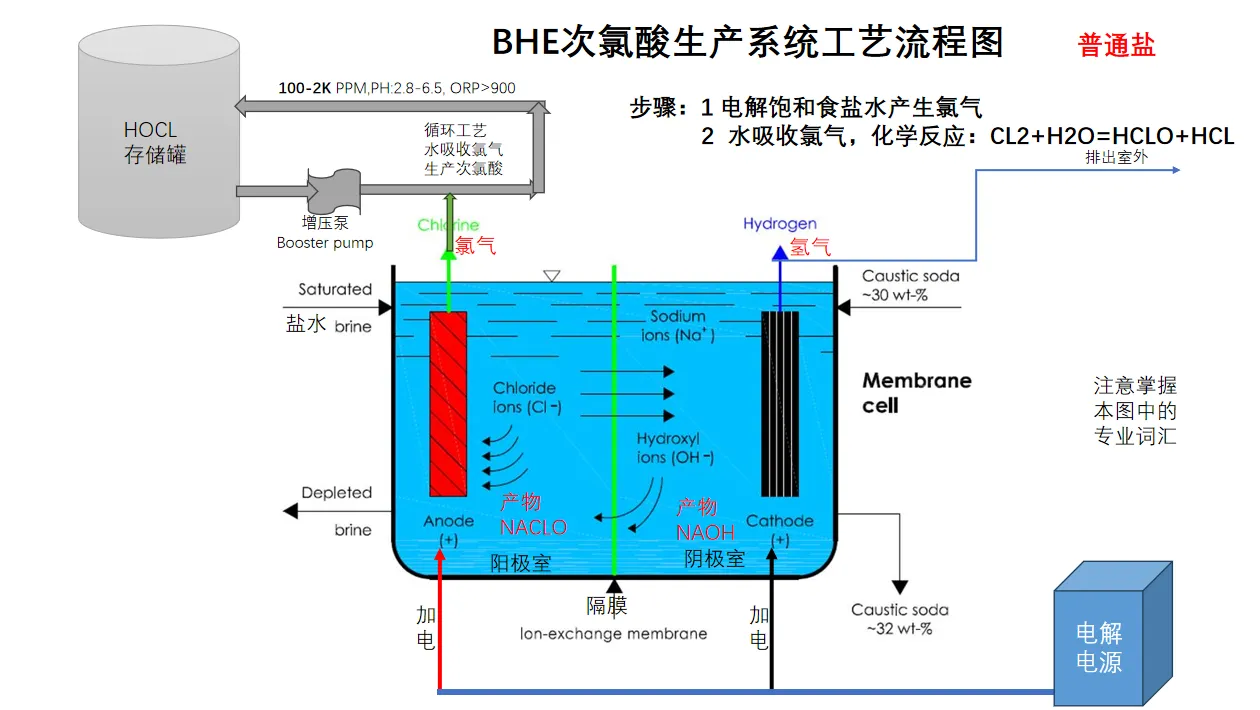
Implementation: The plant replaced sodium hypochlorite with an on-site hypochlorous acid generator, producing HOCl at a concentration of 120 ppm. The solution was continuously dosed into the cooling water circulation system, with periodic shock dosing (180 ppm) every two weeks. The system’s pH was maintained at 6.5-7.0 to maximize HOCl efficacy.
Results: After 4 weeks of operation, biofilm on heat exchanger surfaces was completely removed, and heat transfer efficiency recovered to the design level. Algae in the cooling tower basin were eradicated, with no re-proliferation observed over 6 months of continuous use. Pipeline corrosion rates decreased by 80% compared to the sodium hypochlorite period, and annual maintenance costs (including equipment repair and chemical usage) were reduced by 35%.
Case 2: Biofilm Control in Reverse Osmosis (RO) Pre-Treatment for a Semiconductor Factory
Background: A semiconductor factory in South China relied on RO systems to produce high-purity process water. Biofilm growth in the RO pre-treatment pipelines and ultrafiltration (UF) membranes led to frequent membrane fouling, reducing RO flux by 20% within a month and requiring weekly membrane cleaning. Traditional biocides (e.g., isothiazolinone) caused membrane degradation over time and left residual organic matter, affecting water purity.
Implementation: The factory introduced hypochlorous acid as a pre-treatment biocide, dosing 80 ppm HOCl into the raw water before the UF membrane. The HOCl was in contact with the water for 30 minutes, followed by a neutralization step (if needed) to ensure no impact on the RO membrane. The generator was integrated with the existing water treatment control system for automatic concentration monitoring and dosing.
Results: Biofilm formation on UF membranes and pre-treatment pipelines was effectively inhibited, with RO flux stability extended from 1 month to 3 months. Membrane cleaning frequency was reduced by 67%, and membrane service life was prolonged by an estimated 1.5 years. The residual organic matter in the RO feed water decreased by 40%, ensuring high-purity process water meets semiconductor production requirements.
Case 3: Algae and Biofilm Control in Industrial Wastewater Treatment Ponds
Background: A food processing factory in North China operated an aerobic wastewater treatment pond (volume 5,000 m³) to treat organic wastewater. During summer months, blue-green algae proliferation occurred in the pond, leading to dissolved oxygen (DO) depletion, foul odors, and reduced wastewater treatment efficiency. Biofilms on the pond’s aeration equipment also hindered oxygen transfer, increasing energy consumption.
Implementation: The factory used a mobile hypochlorous acid generator to dose 100 ppm HOCl into the wastewater pond twice a week. The solution was evenly distributed using the existing aeration system to ensure full contact with algae and biofilms. Additionally, a low-concentration continuous dose (50 ppm) was applied during peak algae growth periods (June-August).
Results: Algae proliferation was controlled within 1 week, with DO levels in the pond returning to normal (2-4 mg/L). Biofilms on aeration equipment were removed, reducing aeration energy consumption by 18%. The wastewater treatment efficiency (COD removal rate) increased by 12%, and foul odors were eliminated, improving the on-site working environment. No negative impact on the pond’s microbial community (critical for organic matter degradation) was observed.
3. Key Considerations for Applying Hypochlorous Acid in Industrial Water Treatment
Based on the above cases, industrial facilities should pay attention to the following points when using hypochlorous acid to control biofilms and algae:
-
Concentration Matching: Adjust HOCl concentration according to the target (biofilm or algae) and water quality. Use 80-150 ppm for routine control and 150-200 ppm for shock treatment of severe biofilm/algae infestations.
-
Water Quality Regulation: Maintain water pH between 5.0-7.5 to maximize hypochlorous acid stability and biocidal activity. Remove heavy metals and suspended solids from water to avoid reducing HOCl efficacy.
-
Dosing Strategy: Adopt continuous dosing for long-term prevention and periodic shock dosing for existing biofilm/algae problems. Ensure uniform distribution of HOCl in the water system to avoid localized under-dosing.
-
Equipment Maintenance: Regularly clean and maintain hypochlorous acid generators to ensure stable concentration output. Monitor biofilm and algae growth periodically (e.g., using biofilm sensors or water sampling) to adjust dosing parameters in real time.
Conclusion
The above cases demonstrate that hypochlorous acid is a high-efficiency, environmentally friendly, and cost-effective solution for controlling biofilms and algae in industrial water treatment. Whether in cooling water systems, RO pre-treatment, or wastewater ponds, hypochlorous acid can effectively solve fouling and efficiency problems caused by biofilms and algae, while reducing equipment corrosion and operational costs. As industrial facilities pursue green and efficient water treatment, hypochlorous acid will play an increasingly important role in optimizing water treatment processes and ensuring stable production.